
Short answer: On Tesla’s latest published numbers, cars with Full Self-Driving (Supervised) go about 5.7 million miles between major collisions — roughly 8× the estimated U.S. average, and about 2.7× farther than the same Tesla fleet driven by hand with active safety on. That comes from fleet telemetry across billions of North American miles. And robotaxi — unsupervised rides for paying customers — is already live in cities including Houston, Austin, and Dallas.
Why this matters
Even if you don’t own a Tesla, this is getting close. The same software that co-pilots owner cars is what Tesla uses to pick people up with nobody in the driver’s seat. Safer assisted driving on ordinary roads, plus real paid rides without a human behind the wheel — that’s the kind of shift that shows up in traffic, insurance, and how cities move people. Not a distant demo reel.
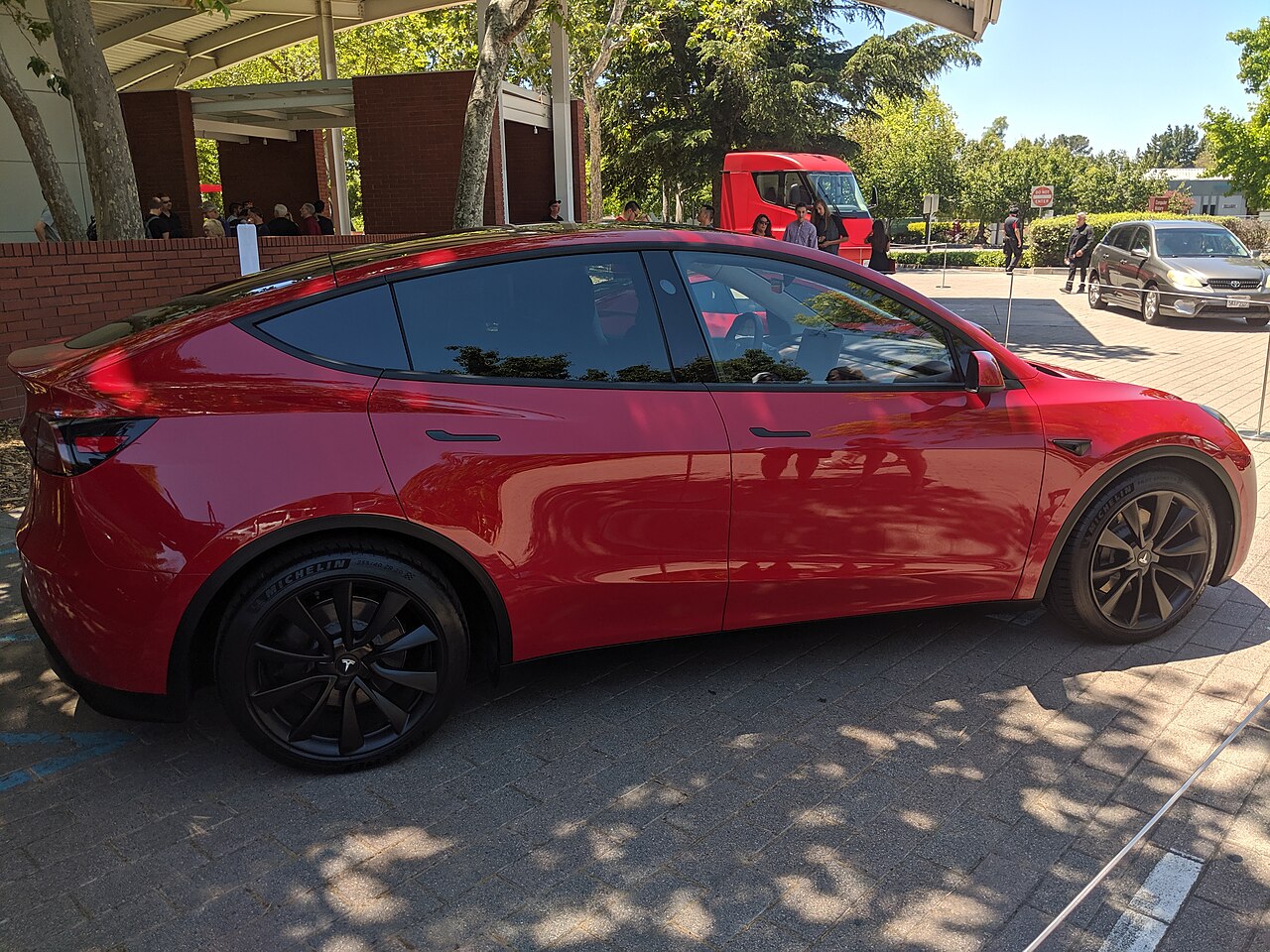
The numbers
Tesla’s rolling twelve-month Vehicle Safety Report for FSD (Supervised) in North America counts a “major collision” when an airbag or other non-reversible restraint deploys — a hard hit, not a parking-lot ding. (Methodology)
| Driving mode | Miles per major collision | Miles in sample |
|---|---|---|
| FSD (Supervised) engaged | 5,690,675 | ~7.14 billion |
| Tesla manual, active safety on | 2,076,014 | ~36.1 billion |
| Estimated U.S. average | 698,781 | ~3.25 trillion |
Source: Tesla Vehicle Safety Report (cited July 2026). An earlier February cut was ~5.3M vs ~660k for the U.S. average — same direction as the fleet grew.
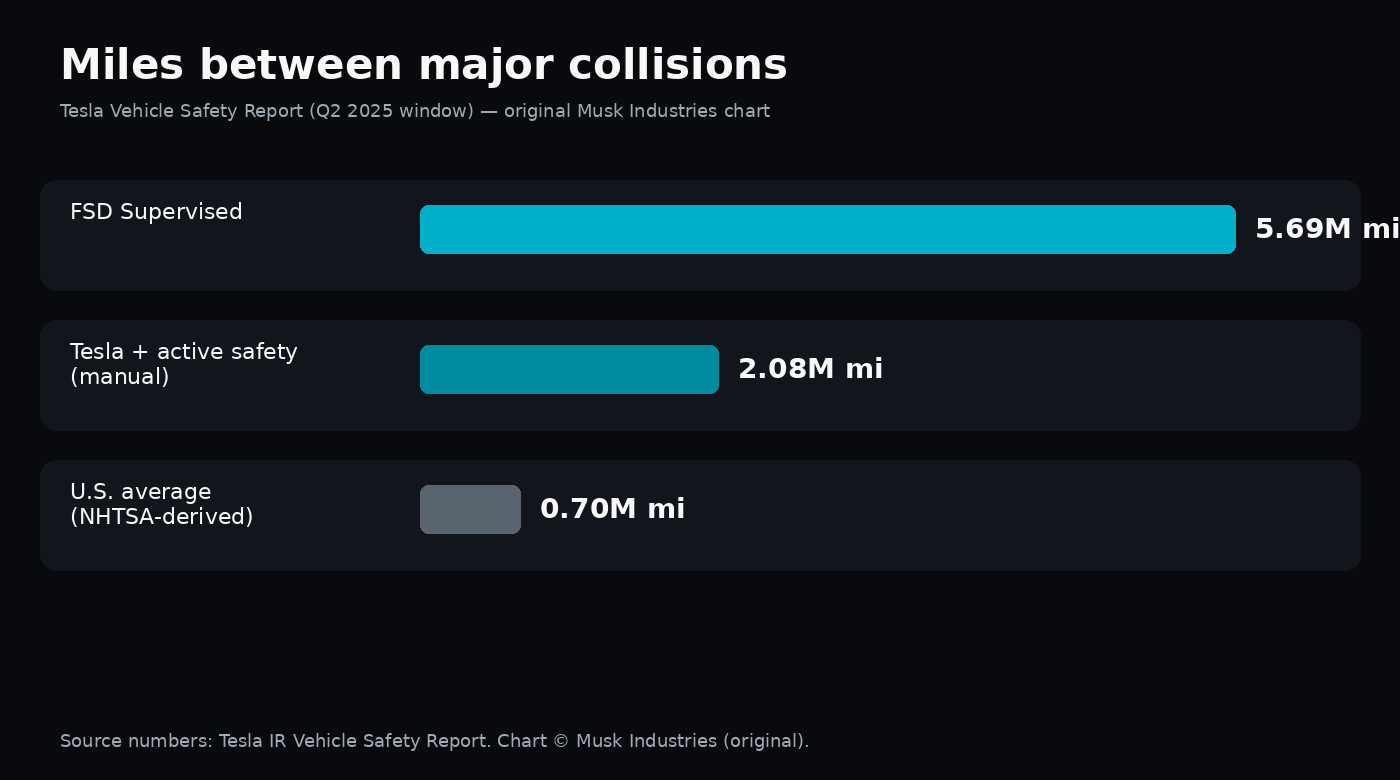
The cleanest line is FSD on versus other Teslas with the same safety hardware (~2.7×). The ~8× gap vs the national average is the headline. Tesla counts a crash under FSD if the system was active in the five seconds before impact, and it doesn’t assign fault — so these aren’t “FSD wasn’t to blame” numbers.
How it learns
Tesla’s bet is simple: see with cameras, then train neural nets on a huge pile of real driving video.
Surround cameras build a feel for lanes, cars, lights, and people. From FSD v12 onward, more of the driving is end-to-end neural net — less handwritten “if cone, then swerve,” more learn from millions of good human examples. Owners on Supervised FSD feed rare edge cases at a scale a small robotaxi fleet can’t match. Cumulative Supervised miles passed 8+ billion in early 2026 (live counter).
That’s why the rates move. The model isn’t a frozen rulebook. It’s a trained driver that keeps getting more examples.
What’s already on the road
Supervised FSD can take you point to point while you stay responsible. Tesla’s own IR line is blunt: active supervision required; it doesn’t make the car autonomous. Capable co-pilot, pilot still in the seat.
Robotaxi is the unsupervised ride-hail. Paying riders summon Model Ys in mapped areas — and in several metros those cars already run with no safety driver.
From Teslas Q2 2026 Update: Austin, Dallas, and Houston are ramping unsupervised; Miami, Orlando, and Tampa joined in July 2026; the Bay Area still uses a safety driver under California rules; Phoenix and Las Vegas are in prep. About 2.5 million paid Robotaxi miles through Q2; Houston and Dallas unsupervised from 18 April 2026; Tesla AI leadership cited 380,000+ unsupervised miles with zero “notable incidents” in that window (company language, smaller sample than the Supervised report).
Geofences, hours, and weather can limit service. Hours are the clearest example: Elon Musk said on 3 October 2026 that the Robotaxi daily cutoff moved from 10 p.m. to 11 p.m., and that the main thing holding back later service is reliably spotting small animals, such as grey cats on dark roads, at night. Early fleets are small. None of that makes Houston imaginary. Unsupervised robotaxi is operating.
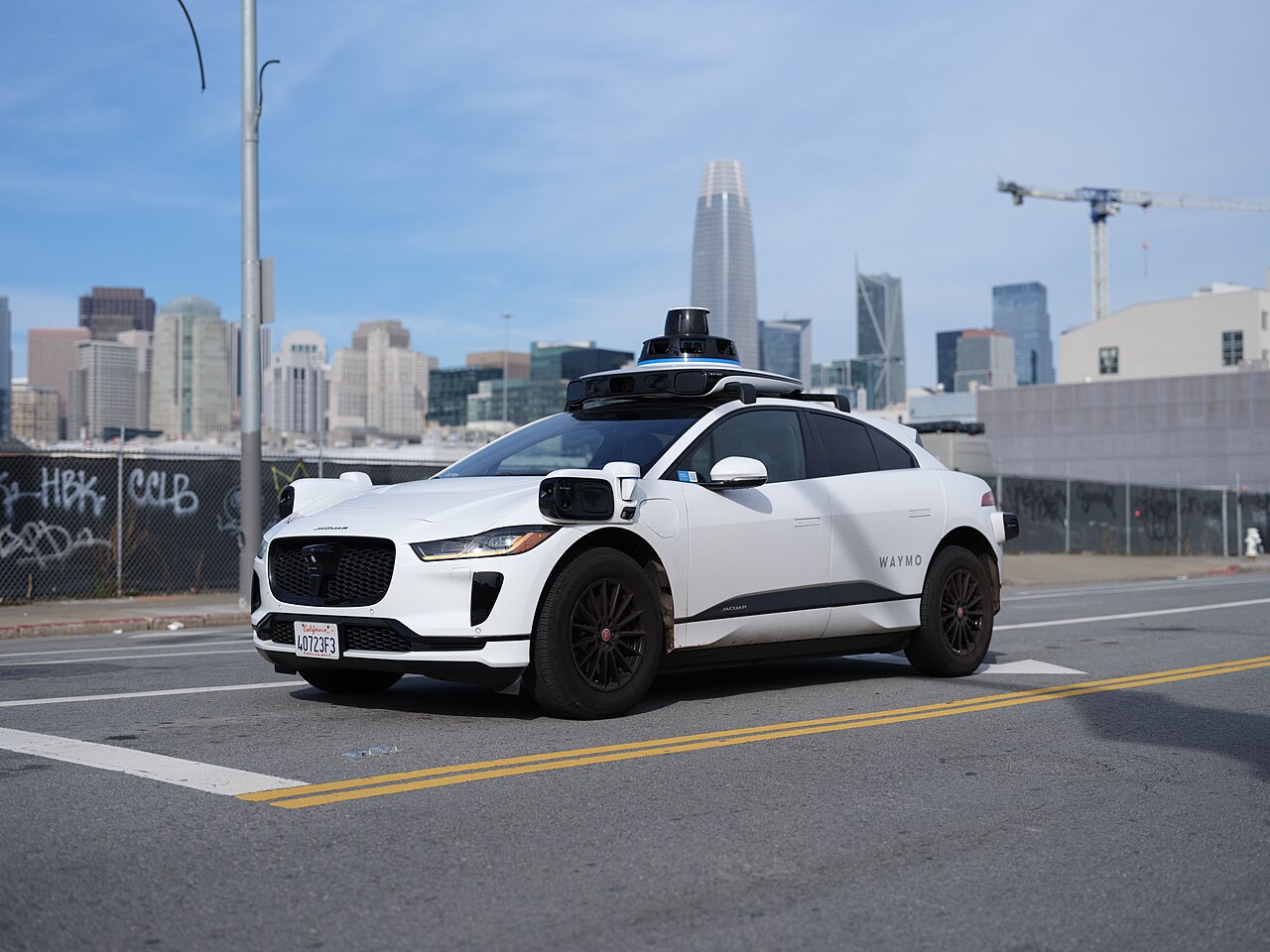
Vs Waymo, briefly: Waymo runs lidar + cameras + radar with deeper published driverless miles — 271+ million rider-only miles through June 2026, and about 82% / 95% fewer injury and serious-injury crashes than human benchmarks in the cities it studied (Waymo Safety Impact; IIHS). Tesla has far more consumer assisted miles and a vision stack that can, in principle, ride in every car it sells. Different yardsticks — both already beating average human crash rates where they measure.
Automatic Collision Evasion
On Hardware 4 cars with an active FSD purchase or subscription (and Automatic Emergency Braking on), Tesla is shipping a feature that can take the wheel when a crash looks imminent — or when the driver looks checked out. Tesla AI lead Ashok Elluswamy called an owner clip of it catching a curb miss a “guardian angel.”
Release notes describe two triggers. One is a highway frontal hazard (under 85 mph, no pedestrians or cyclists detected, road not flagged as slippery) where braking alone may not be enough — the car can steer, brake, or accelerate around it. The other covers an inattentive driver or someone who appears to have switched FSD off by accident. Once it engages, light brake input won’t cancel it; you need firm steering to take back control, and the car chimes when the danger has passed.
It began reaching cars with FSD (Supervised) v14.3.9 in update 2026.27.6, with follow-on builds through late September 2026. HW3 gets FSD v14.2 Lite in the same waves — without collision evasion. Earlier hazard prediction and faster avoidance are slated for FSD v15.
Secondary report of the owner video and staged rollout: Teslarati. Prefer Tesla’s in-car release notes as the authority for trigger limits.
Milestone board (we update these in place)
| When | What happened |
|---|---|
| Jun 2025 | Robotaxi launches in Austin (monitors first) |
| Feb 2026 | >8B Supervised FSD miles; ~5.3M mi / major collision |
| 18 Apr 2026 | Unsupervised Robotaxi live in Houston and Dallas |
| Q2 2026 | ~2.5M paid Robotaxi miles; Cybercab production starts |
| Jul 2026 | Unsupervised in Miami, Orlando, Tampa; safety table ~5.69M mi / major collision |
| Sep 2026 | Automatic Collision Evasion ships on HW4 with FSD v14.3.9+ |
| 3 Oct 2026 | Robotaxi daily cutoff moves from 10 p.m. to 11 p.m.; night-time pet detection is the stated limit |
Ongoing: bigger geofences, more Cybercab data, Phoenix / Las Vegas prep.
Bottom line
Supervised FSD is already logging billions of miles with major-collision rates that beat both the U.S. average and manually driven Teslas in Teslas own tables. Unsupervised Robotaxi is already picking up paid riders in Houston and other cities. Cameras in, neural nets out, trained on fleet video — that’s why the curve keeps moving.
Watch the quarterly Vehicle Safety Report and the Robotaxi city list. Those two pages tell you more than any demo video.
Sources
- Tesla FSD Vehicle Safety Report
- Tesla Vehicle Safety Report methodology
- Tesla Q2 2026 Update (IR PDF)
- Waymo Safety Impact
- IIHS on Waymo crash rates
- Elon Musk on X, 3 Oct 2026: Robotaxi hours moved to 11 p.m.
- Teslarati — Automatic Collision Evasion owner video / rollout (secondary)
Musk Industries is an independent archive — not affiliated with Tesla, Elon Musk, or related companies. Not financial advice.
Pingback: How many Tesla Cybercabs are already giving rides? - Musk Industries