
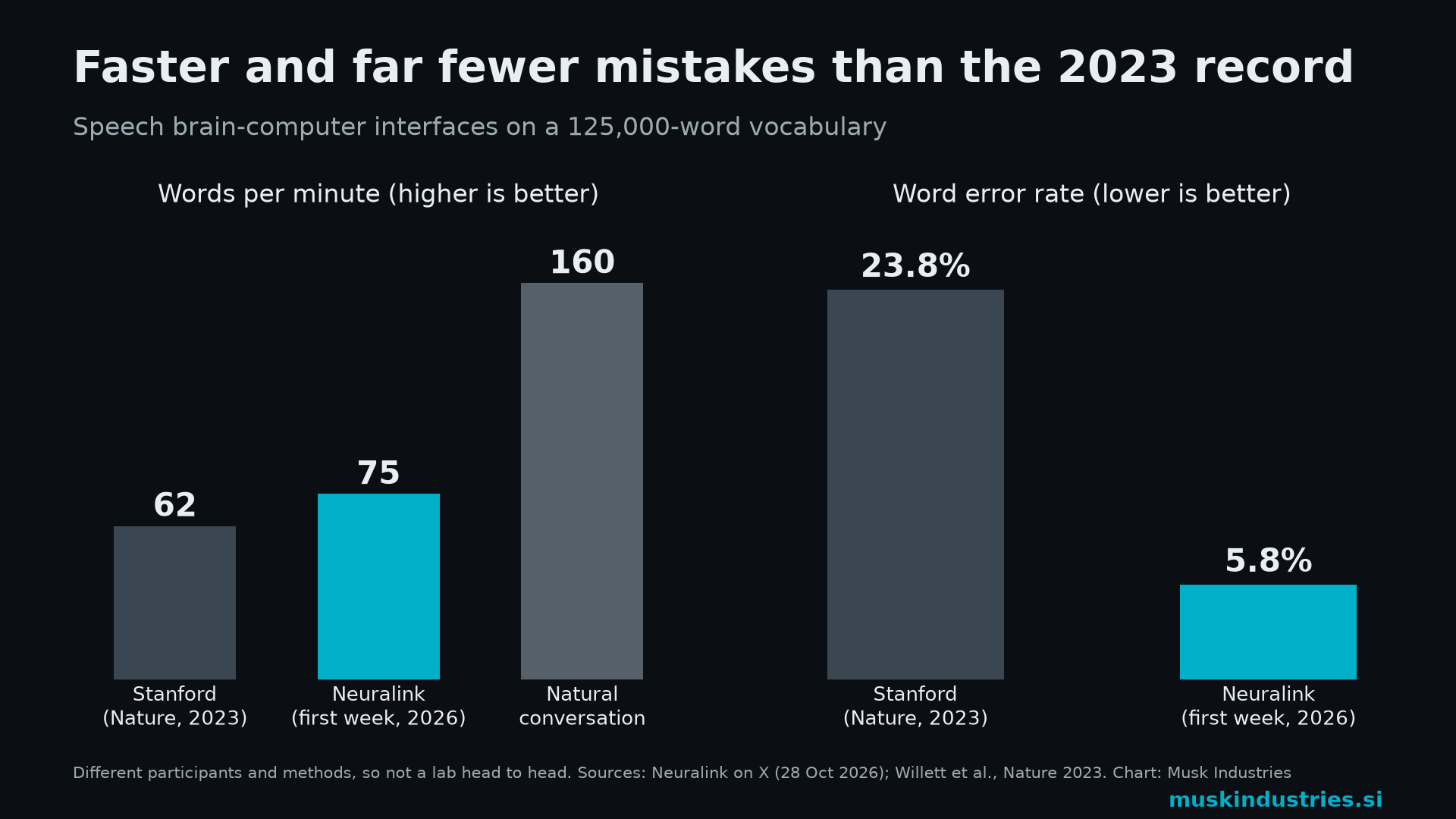
Short answer: It is starting to, in a small early study. Neuralink says one participant with ALS in its VOICE study reached 75 words per minute with a 5.8% word error rate on a 125,000-word vocabulary in their first week. That is faster and far more accurate than the best published result from 2023, though still about half the speed of normal conversation, and the device is not approved for general use.
Why it matters
ALS gradually takes away a person’s ability to move and, for many, to speak. Losing your voice means losing phone calls, jokes, and quick conversations with the people you love. A brain implant that turns the words you intend to say into text and speech could give some of that back, and the numbers Neuralink shared this week suggest it is getting closer to everyday use.
How it works
The implant listens to the speech part of the brain. The N1 Implant is a small, wireless, rechargeable device that sits in the skull. Very thin threads, placed by Neuralink’s R1 surgical robot, pick up signals from neurons involved in speaking.
Software turns those signals into words. A decoder learns which patterns go with which sounds and words, then outputs text and a synthetic voice. Neuralink says one participant, Terry, first trained the system by miming speech and then by simply thinking the words and hearing them back in his own voice.
A large base model helps. Neuralink says its participants have used their implants for more than 50,000 hours, and that it used this data to pretrain a foundation model for brain-computer interfaces, so new users start from more than a blank slate.
What’s real now
- A real clinical study: VOICE (NCT07224256) is an early feasibility study that started in October 2025 at UT Southwestern Medical Center in Dallas. It is recruiting adults with severe, irreversible speech loss and impaired arm and hand function, from causes including ALS, spinal cord injury and stroke. The planned enrolment is 6 people.
- Peer meeting data: the 75 words per minute result was presented at the 2026 Annual NEALS Meeting, a gathering of ALS clinical researchers, by Dr. Nader Pouratian, the study’s principal investigator.
- Everyday tools, not just lab tests: on 29 October 2026 Neuralink described a 72-hour sprint at a participant’s home. Engineers built automatic detection of when he is trying to speak (no button needed), a mobile app called Bloom, an iPhone keyboard for dictation, faster error editing, and a way to send his generated voice straight into phone calls. Neuralink says watching him and his wife joke on the phone again was a highlight of the week.
- Still investigational: Neuralink notes that its devices have not been approved by the FDA or other regulators, and that one participant’s experience may not reflect everyone’s.
The numbers
| Result (125,000-word vocabulary) | Words per minute | Word error rate |
|---|---|---|
| Neuralink VOICE, one participant, first week (2026) | 75 | 5.8% |
| Stanford, one participant with ALS (Nature, 2023) | 62 | 23.8% |
| Natural conversation (as cited in the Nature paper) | about 160 | n/a |
Word error rate is the share of words the system gets wrong. At 5.8%, roughly one word in 17 needs fixing.
What’s next
- More participants: the study aims to enrol 6 people, with primary completion listed for October 2028. Results from more than one person will show how well this holds up.
- Closing the speed gap: 75 words per minute is fast for a brain interface but still about half of normal speech. Watch for speed and accuracy updates as the decoder trains on more data.
- Approval: nothing here is approved yet. For how Musk company timelines tend to land, see the Musk Timeline Tracker.
Sources
- Neuralink on X, 28 October 2026: 75 WPM, 5.8% WER, 125k vocabulary, first week; NEALS presentation and VOICE study posts. Primary.
- NEALS 2026 abstract, Muscle & Nerve, linked by Neuralink.
- ClinicalTrials.gov NCT07224256 (VOICE): site, start date, enrolment, eligibility, device. Primary.
- Neuralink, “A 72-Hour Engineering Sprint for Translating Thought to Speech”, 29 October 2026. Primary.
- Neuralink on X about Terry thinking words in his own voice (18 September 2026) and 50,000 hours and a BCI foundation model (2 October 2026). Primary.
- Willett et al., “A high-performance speech neuroprosthesis”, Nature, 2023: 62 WPM, 23.8% WER, 160 WPM natural conversation. Primary.
Top image and chart: Musk Industries originals from the sources above.
Musk Industries is an independent archive, not affiliated with Tesla, SpaceX, Neuralink, Elon Musk or related companies.