
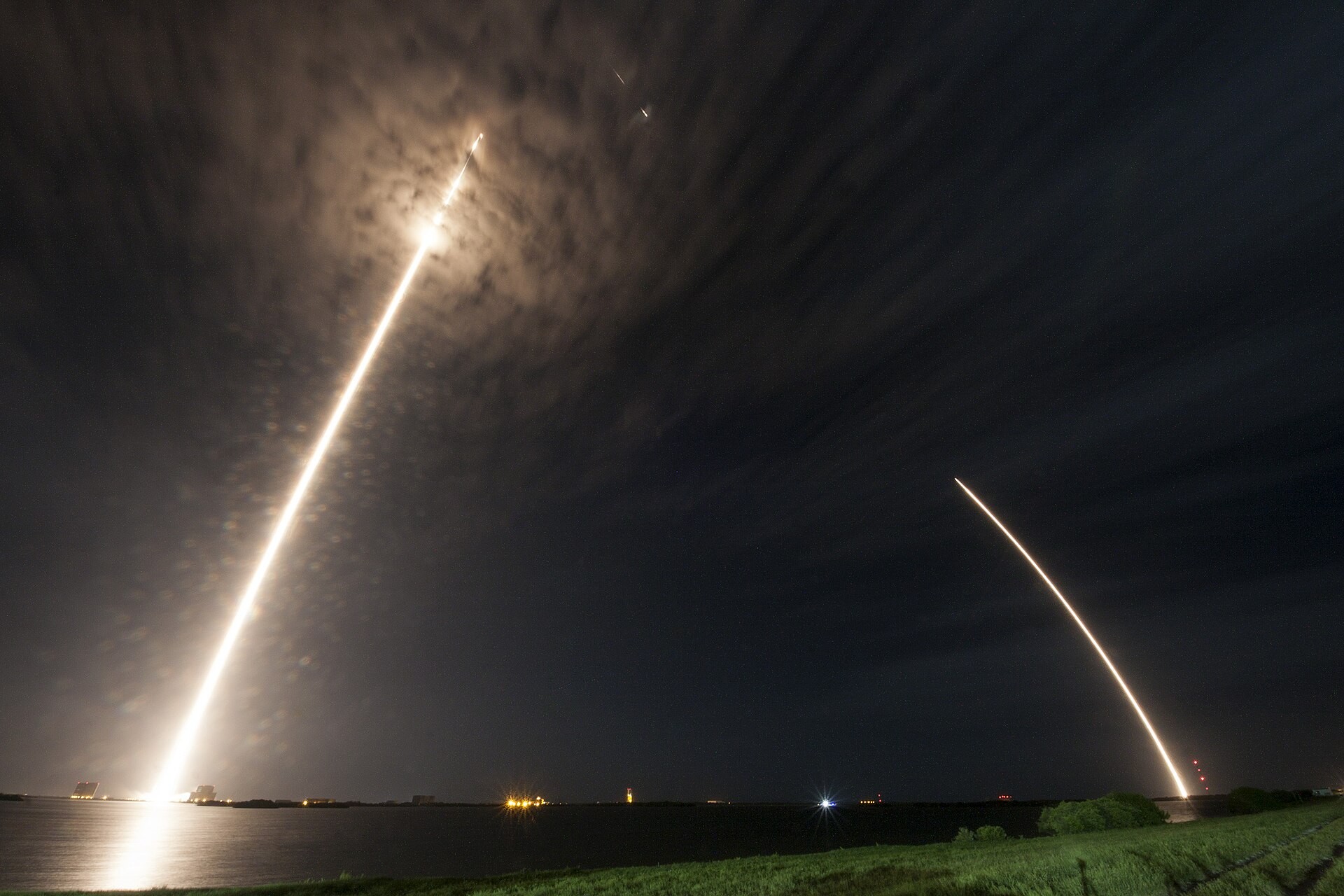
Short answer: Yes — and it’s now in orbit. Google’s first Project Suncatcher test satellite — fridge-sized, four of Google’s own TPU AI chips — launched on SpaceX’s Transporter-18 rideshare on 1 Oct 2026, and Google says it has contact and the satellite is operating as expected. The point is not a full orbital data centre yet. It’s whether those chips survive launch, radiation, and vacuum cooling so bigger constellations can follow.
Why it matters
AI data centres eat power. In low Earth orbit, solar panels can harvest near-constant sunlight — Google’s research notes up to about eight times more solar energy than a comparable ground setup. If the hardware works up there, space becomes a real option for scaling compute without fighting terrestrial grids. SpaceX is not just the taxi: it is building its own much larger orbital AI satellites in parallel.
How Suncatcher works
Per Google’s own Project Suncatcher update (24 Sep 2026):
- Hardware under test: Trillium TPUs — the same family Google runs in ground data centres — on a Planet-built prototype called MVP
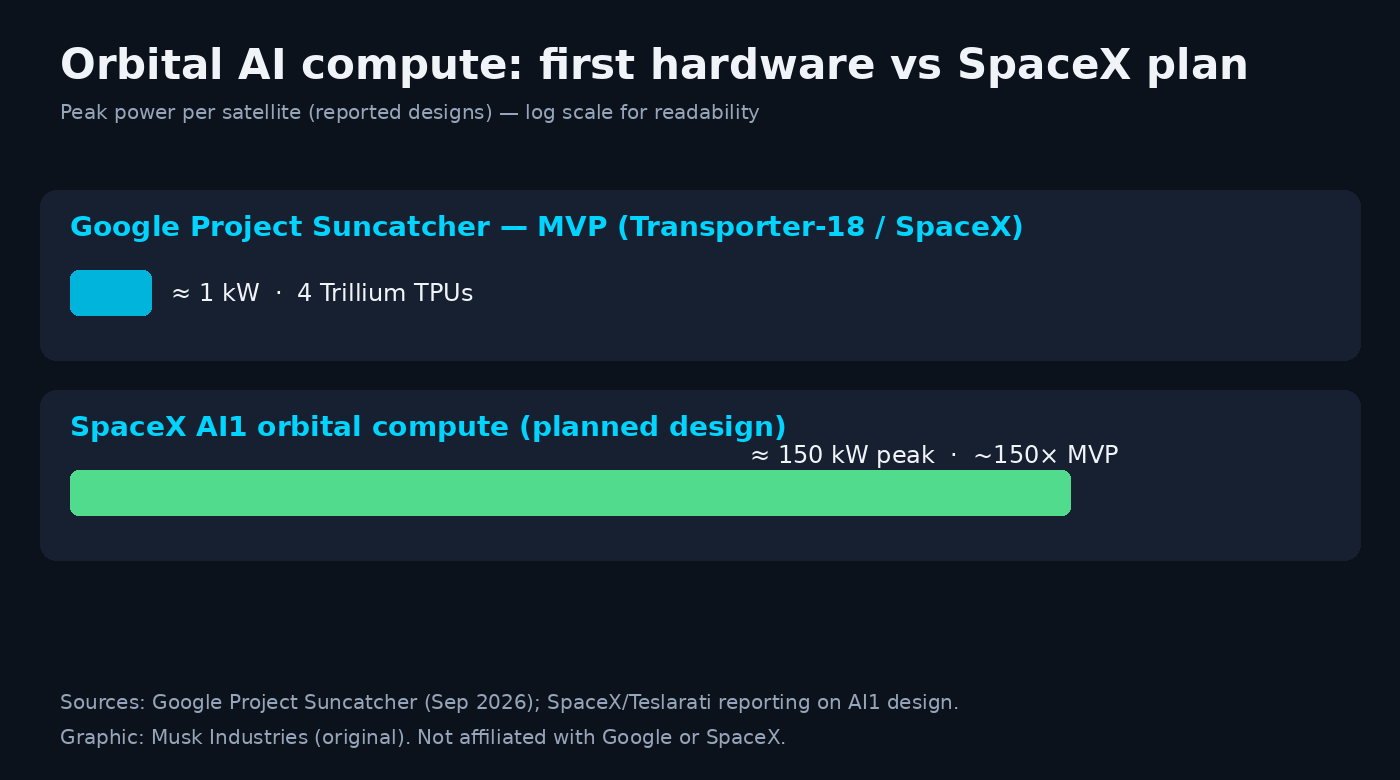
- Power: about 1 kW from solar panels; Gemini workloads in roughly 15-minute bursts so radiators can dump heat
- Launch stress: vibration testing mimicked sustained ~10g loads (components seeing 50–100g)
- Radiation: proton-beam tests at UC Davis; Google says the TPUs handled a total ionizing dose beyond a five-year LEO mission
- Cooling: no air in vacuum — heat pipes + radiators only; already exercised in a thermal-vacuum chamber
Next step after this learning flight: a 2027 two-satellite demo of high-bandwidth laser links between craft flying in tight clusters.
What’s real now
Over the coming weeks Google says it will collect in-orbit data on how the TPUs cope with launch stress, radiation, and heat — the real test of whether the ground results hold up. Google is treating this as a research moonshot, not a product launch. Its own cost modelling still wants launch prices under roughly $200/kg before orbital compute beats ground sites on energy cost — a mid-2030s-ish threshold in their public framing.
SpaceX’s parallel track is more aggressive: an AI1-class satellite derived from Starlink V3 hardware, designed around ~150 kW peak compute (about 150× MVP’s draw), with filings and public comments pointing at million-satellite-scale orbital compute and a Gigasat production push in Texas. Google also holds a reported ~6% stake in SpaceX — so the rideshare is both partnership and competition.
Milestone board (we update these in place)
| When | What |
|---|---|
| Nov 2025 | Google announces Project Suncatcher research moonshot |
| 24 Sep 2026 | Google details MVP flight hardware + Transporter-18 / SpaceX rideshare |
| 1 Oct 2026 | Transporter-18 lifts off from Vandenberg (11:32 a.m. PT) with 130 payloads; Suncatcher M1 deploys about 61 minutes later; Google confirms contact and normal operation — first Google TPUs in orbit |
| 2027 | Planned two-satellite laser-link demo; SpaceX AI1 path continues in parallel |
Useful share line: Google just put real AI chips into orbit on a SpaceX rocket to see if space can host the next wave of compute — while SpaceX builds a much bigger orbital AI stack of its own.
Sources
- Our Project Suncatcher prototype satellite is in orbit (Google, 1 Oct 2026)
- SpaceX — Transporter-18 mission page (launch time, deploy timeline)
- Behind Project Suncatcher (Google, 24 Sep 2026)
- Meet Project Suncatcher (Google Research, Nov 2025)
- Reuters — Google plans first in-orbit TPU test
- Teslarati — Google / SpaceX orbital AI context (secondary)
Musk Industries is an independent archive — not affiliated with Google, SpaceX, Tesla, Elon Musk, or related companies.