
Short answer: Chatbots answer. Agents execute. In 2026, products like xAI’s Grok Bot, Meta’s Muse, and OpenAI’s Dots run on their own cloud computers, work inside real apps and browsers, and keep going after you close the laptop — then ping you when something needs approval. The category is real. “Finish every job unsupervised” is still constrained by approvals, blocked sites, and session expiry.
Acronyms: AI = artificial intelligence. CRM = customer relationship management (sales/contact software). VM = virtual machine (a computer that runs in the cloud).
Why this matters
For a few years, “AI” mostly meant a chat window that drafts and explains. Useful — and still you were the glue: copy the draft, open the CRM, paste the follow-up, babysit three more tabs. Agents are the pitch that the glue goes away. The work is supposed to land where a human would put it, because the agent has a computer of its own and can keep clicking while you’re offline. If that holds up, “ask AI a question” turns into “give AI a shift.”
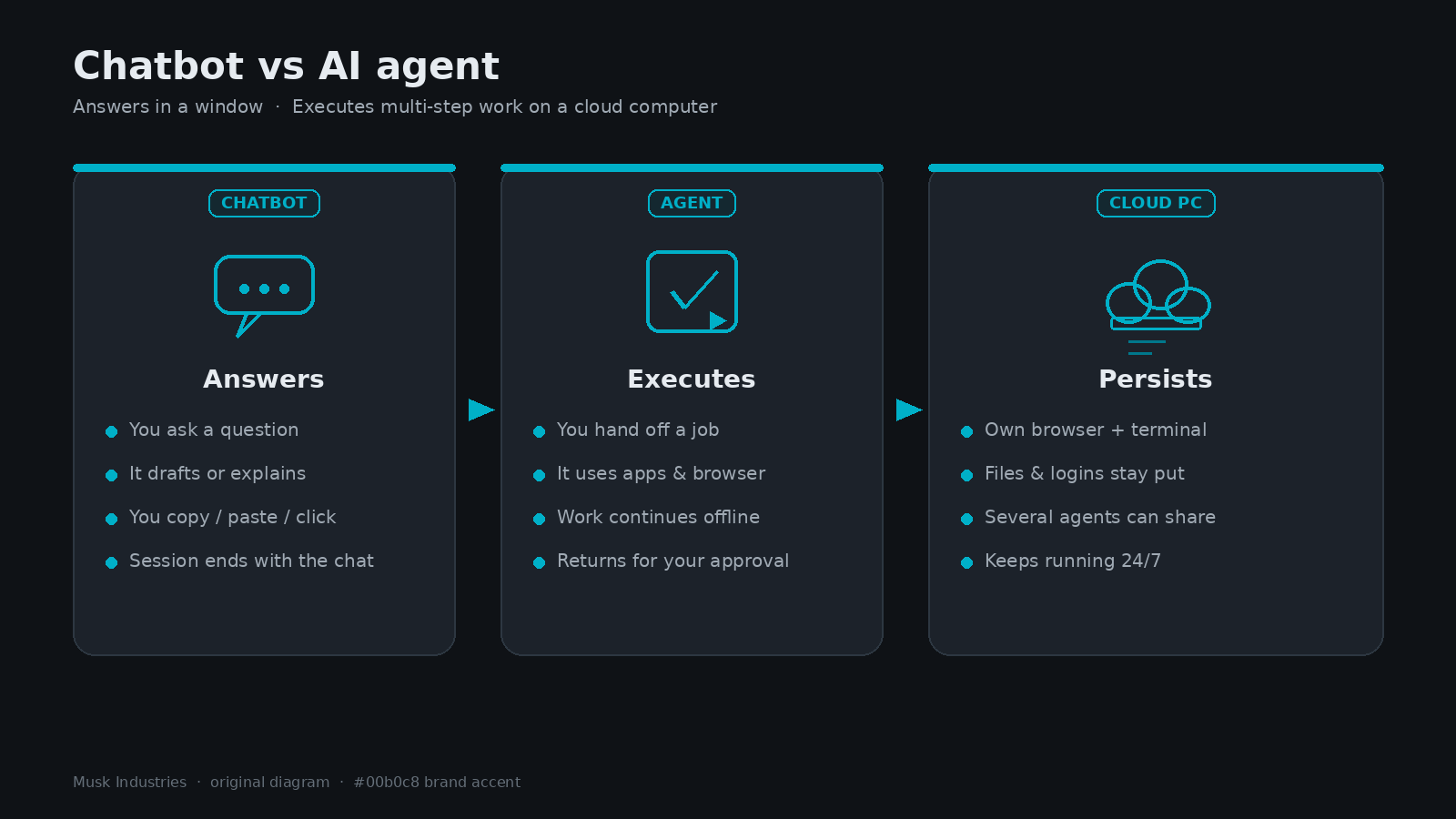
Chatbot vs agent (plain English)
A chatbot responds in the conversation. You stay the operator: every next click, every paste into another app, every “now do the other half.”
An agent takes a multi-step job across tools. It uses connectors or plugins when they exist, and computer use — seeing a screen and clicking like a person — when they don’t. It keeps working on a cloud machine after you close the app, then comes back when it needs judgment, money, or a send you haven’t approved.
Same family of models. Different job. Answers vs execution.
Grok Bot (xAI / Cursor)
Covered in depth on this site already — see What is Grok Bot?. The short version for this wave piece:
- What it is: named AI teammates you message like colleagues. They share one persistent cloud computer per account (browser, filesystem, terminal) and can run in parallel, message each other, and sit in a group chat so you are not the router.
- How you start: create a Bot, describe the job, grant access as it asks — not a workflow builder first. You can walk it through a path once; it can save that as a skill or routine and rerun it later.
- What’s shipped: public beta (Aug 2026) on desktop and iOS for SuperGrok plans and paid Cursor plans; own usage bucket separate from ordinary Grok/Cursor chat; enterprise waitlist. Consequential steps are meant to stay gated to you.
- Honest line from the docs: sites can still block automation, sessions expire, and some steps need a human — the Bot is supposed to hand those back rather than invent a workaround.
Primary: xAI launch note and Cursor Grok Bot docs.
Muse and Dots — not one product
People sometimes say “Muse Dots” as if it were a single app. It isn’t. Meta launched Muse (8 Sep 2026). OpenAI launched Dots (29 Sep 2026). Same product class — personal agents with cloud computers — different companies.
Meta Muse is framed as a personal life agent: goals, calendar, email, shopping, travel, and everyday admin. It runs on Muse Secure VM (a dedicated secure computer with its own browser). A separate Sentinel gate is described as controlling what reaches the internet; sensitive actions like sending email or buying something ask the person first. Roll-out: US on iOS, Android, and muse.ai, free for most everyday use with paid plans for more. Primary: Meta’s Introducing Muse.
OpenAI Dots are always-on agents inside ChatGPT — give a Dot a name and ongoing work, connect plugins (OpenAI cites 4,000+ apps), and let it keep progress between conversations on its own cloud computer, powered by GPT‑6 Astra. Access at launch: eligible ChatGPT Pro, Business Premium, and Enterprise (admin opt-in) in supported markets; Custom Rules and Autoreview-style gates for what it may do alone vs with approval. Primary: OpenAI’s Introducing dots and OpenAI Help on dots privacy/safety.
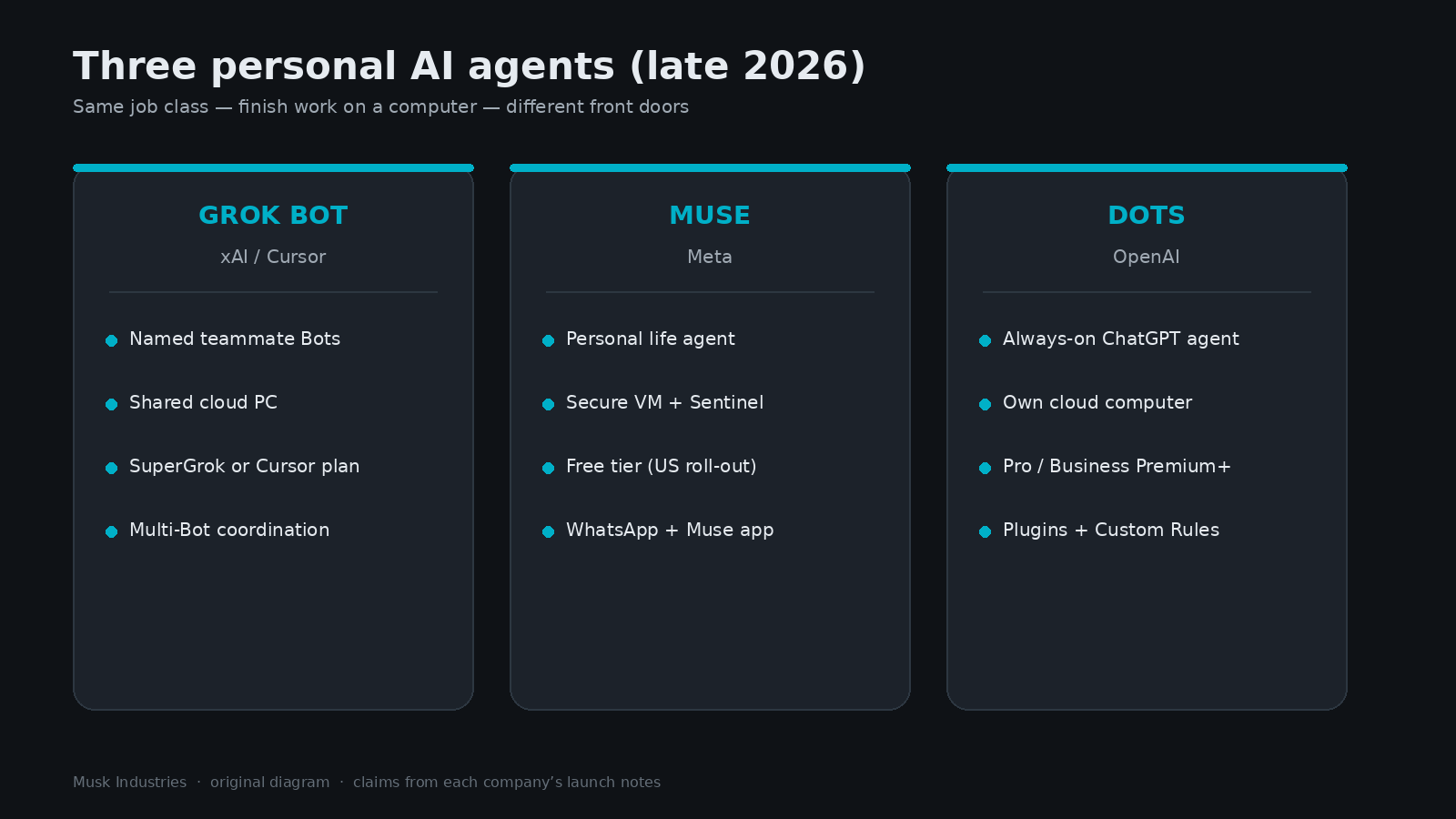
How that stacks up
| Product | Maker | Front door | Computer model | Who gets it (as published) | Stated strength |
|---|---|---|---|---|---|
| Grok Bot | xAI / Cursor | Desktop + iOS apps | One shared cloud PC per account; multi-Bot team | SuperGrok + paid Cursor plans (beta) | Parallel specialist Bots + skills from one walkthrough |
| Muse | Meta | Muse app, muse.ai, WhatsApp | Muse Secure VM + Sentinel | US free tier + paid plans | Everyday life admin, broad free entry |
| Dots | OpenAI | ChatGPT (+ Slack / Teams for work) | Own cloud computer + plugins | Pro / Business Premium / Enterprise beta | Always-on work agent inside ChatGPT’s plugin world |
Achievement-first read: all three are shipping the same bet — persistent computer + connectors + approval gates — not just a smarter reply box. Muse leads on free consumer access. Dots sit closest to people already living in ChatGPT and work chat. Grok Bot leans hardest into a small team of named Bots that coordinate so you aren’t the middleman. None of that is a scoreboard win; it’s where each company put the door.
Older “computer use” tools (OpenAI’s Operator-style browser agents, Anthropic Computer Use, Google Gemini computer use) still matter as the underlying click-the-UI skill. The 2026 consumer products above package that skill as a named teammate with memory and a machine that stays on.
What’s real vs demo theater
Real now (per the companies’ own launch notes and docs): cloud computers that keep running; messaging as the interface; connectors/plugins; approval prompts before consequential sends and spends; beta or limited geographic roll-outs.
Still fragile — treat as product lines, not failure modes to bury:
- Approvals: agents are designed to stop for judgment calls. That is the honest design, not a bug.
- Blocked sites: retailers and platforms can refuse automation; agents should hand the step back rather than invent a workaround.
- Session expiry: logins die; CAPTCHAs and human-only gates still exist.
- 90% vs 100%: drafts and half-filled forms are easy; landing the finished work in the right tool, without you as paste bridge, is the bar that separates theater from a finished job.
Milestone board (we update these in place)
| When | What happened |
|---|---|
| 2024–2025 | Computer-use previews (Operator / Claude Computer Use / Gemini-style browser agents) prove click-the-UI is possible |
| Aug 2026 | Grok Bot public beta — always-on teammates with shared cloud computers (xAI) |
| 8 Sep 2026 | Meta Muse — personal agent on Muse Secure VM (Meta) |
| 29 Sep 2026 | OpenAI Dots — always-on ChatGPT agents with cloud computers (OpenAI) |
| Ongoing | Watch finish rates on multi-step jobs, approval clarity, and whether free vs paid access shapes who actually uses agents daily |
Agents are not replacing chatbots overnight — chat is still the best face for questions, drafts, and explanation. What changed in late 2026 is that the same labs shipped products whose job is to execute across your real tools. Watch whether they reliably close the last 10% without you as the paste bridge — and whether the approval gates stay clear as people trust them with more.
Sources
- Introducing Grok Bot (xAI)
- Grok Bot docs (Cursor)
- What is Grok Bot? (Musk Industries explainer)
- Introducing Muse (Meta / about.fb.com)
- Introducing Muse (Instagram for Creators)
- Introducing dots (OpenAI)
- Dots privacy, security, and safety FAQs (OpenAI Help)
- Naming note: there is no single verified product called “Muse Dots”; Meta’s Muse and OpenAI’s Dots are separate launches in the same agent class.
Musk Industries is an independent archive — not affiliated with Tesla, Elon Musk, xAI, Cursor, Meta, OpenAI, or related companies. Not financial advice.