
Short answer: SpaceX’s Dragon is the only spacecraft flying today that can bring a significant amount of cargo back from orbit, up to 3,000 kg per trip. It packs research samples into its pressurized capsule, undocks from the International Space Station, drops its trunk, falls back through the atmosphere and lands under six parachutes in the ocean off California. The cargo Dragon heading home this week is on its fourth trip to the station.
Why it matters
A lot of space station science only pays off back on Earth. Frozen cells, tissue samples and bacteria need full ground laboratories to study properly, and broken hardware needs engineers to look at it. Plenty of ships can carry supplies up to the station, but most of them burn up on the way down. Dragon is the one that brings the work home intact, and SpaceX reuses the capsule to do it again.
How it works
The ride up. On CRS-35, a Falcon 9 launched Dragon from Cape Canaveral, Florida, on 13 October 2026 at 6:33 a.m. ET. It reached the station two days later carrying more than 6,300 pounds of crew supplies, science and equipment, according to NASA.
Two parts. Dragon has a pressurized capsule of 9.3 cubic meters, where environmentally sensitive cargo rides, and an unpressurized trunk of 37 cubic meters. Half of the trunk is covered in solar panels that power Dragon in flight and while docked.
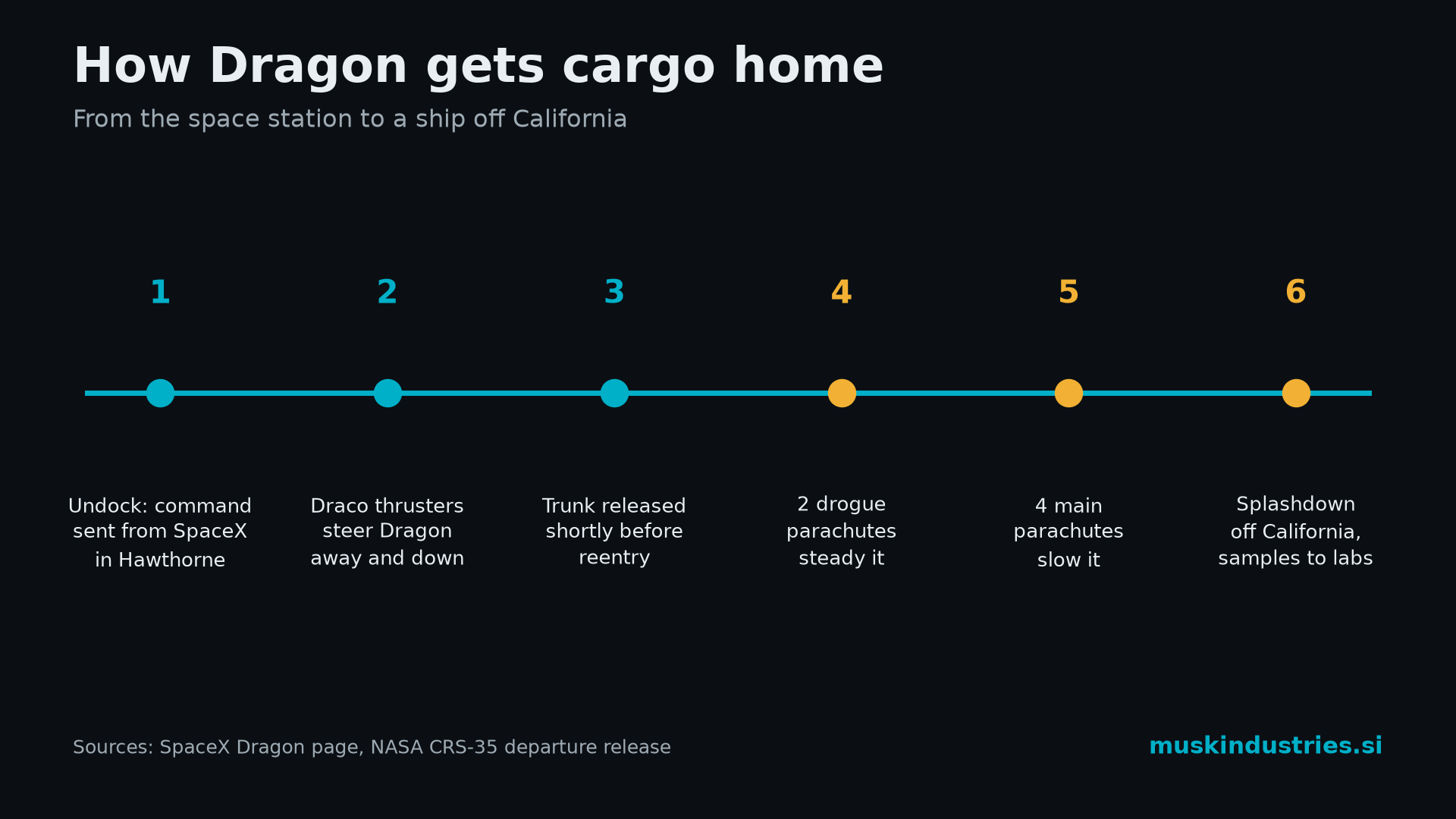
The trip home. Ground controllers at SpaceX in Hawthorne, California send the command to undock. Dragon’s 16 Draco thrusters handle its orbit changes, the trunk stays attached until shortly before reentry, and then the capsule falls back through the atmosphere. Two drogue parachutes steady it, four main parachutes slow it, and it splashes down off the California coast for recovery.
What’s real now
- Coming home this week: after 34 days docked, the CRS-35 Dragon is set to undock no earlier than Wednesday 18 November at 11:05 a.m. EST (16:05 UTC), with splashdown off California targeted no earlier than 10:50 p.m. PST that night (06:50 UTC on 19 November). Weather can move both times.
- What’s on board: NASA says thousands of pounds of cargo are returning, including a 3D bioprinted blood vessel construct used to study vascular aging and heart disease, frozen tumor organoids treated on the station to help improve cancer treatment, frozen microbial samples to study how antibiotic resistant bacteria adapt in space, and a lighting system tested for more than three years to support astronauts’ sleep.
- A reused capsule: this Dragon previously flew CRS-26, CRS-29 and CRS-33 to the station and back, so CRS-35 is its fourth round trip.
- Same family as crew Dragon: the Dragon design also flies astronauts, carrying up to seven people, and since 2020 it has flown NASA crews to and from the station.
Numbers
| Dragon | Figure |
|---|---|
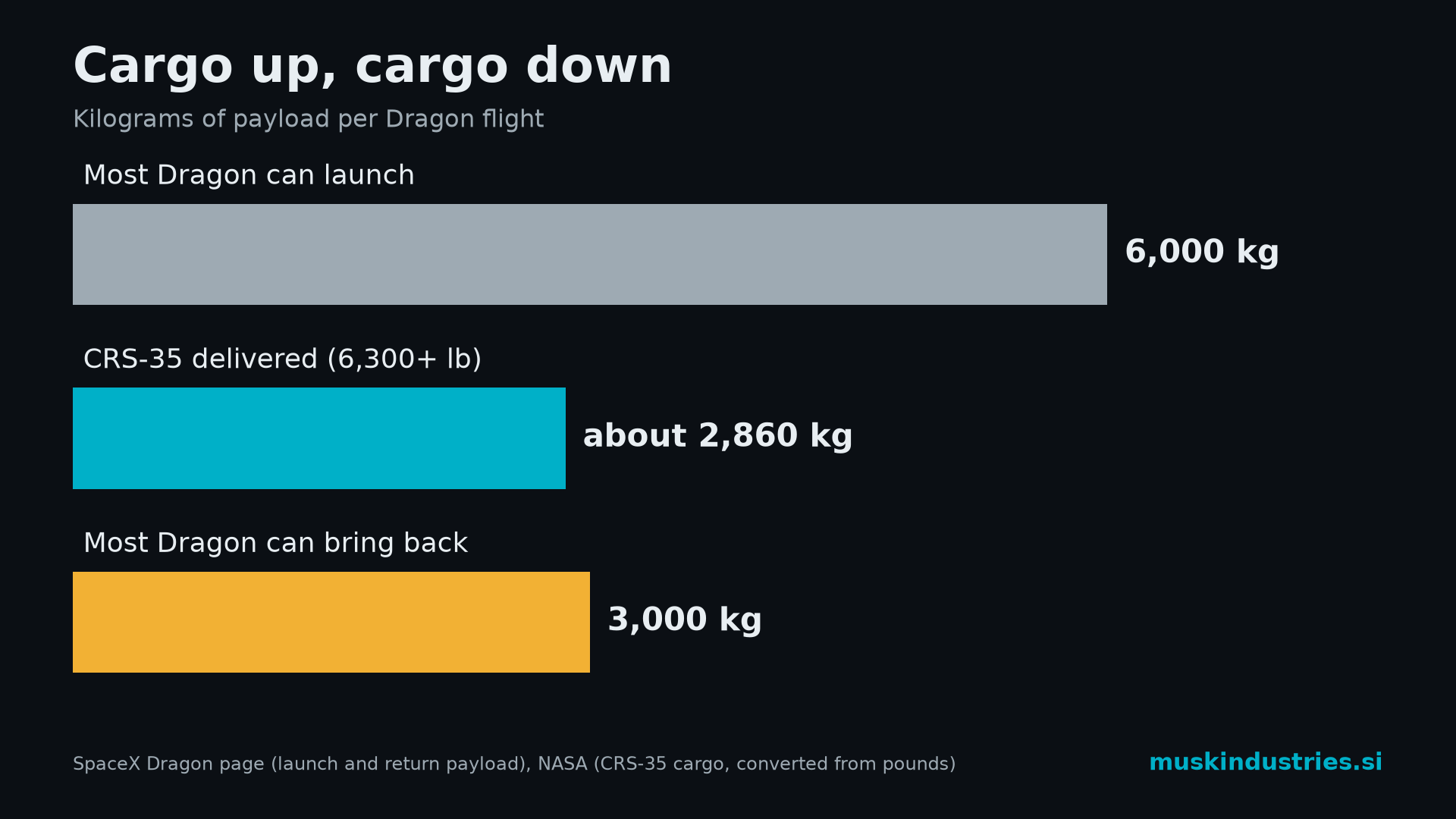
| Launch payload | Up to 6,000 kg |
| Return payload | Up to 3,000 kg |
| Pressurized volume | 9.3 m³ |
| Trunk volume | 37 m³ |
| Draco thrusters | 16, each 400 N in vacuum |
| Parachutes | 2 drogue, 4 main |
| CRS-35 cargo delivered | More than 6,300 lb (about 2,860 kg) |
| CRS-35 time docked | 34 days |
What’s next
- Splashdown and science: once Dragon is recovered, the samples go to researchers. NASA posts splashdown updates on its space station blog, and we will update this page with the result.
- Bigger reuse: Dragon proved reusable spacecraft for cargo and crew. SpaceX is now pushing the same idea to its biggest rocket; see Why is catching Starship such a big deal?
- Track the promises: Musk’s space and self driving dates live on the Musk Timeline Tracker, and Tesla’s robotaxi count is in How many Tesla Cybercabs are on the road?
Sources
- SpaceX: Dragon: only spacecraft currently flying that can return significant cargo; launch and return payload, volumes, trunk, Draco thrusters, parachutes, crew capacity. Primary, read 18 November 2026.
- SpaceX: CRS-35 Mission: 34 days docked, undock no earlier than 18 November, fourth flight of this capsule (CRS-26, CRS-29, CRS-33), launch 13 October. Primary.
- NASA: coverage of the 35th SpaceX resupply mission departure: undock and splashdown times, returning research, more than 6,300 pounds delivered. Primary.
- SpaceX on X, 17 November 2026 (UTC): Dragon targeted to undock as soon as 18 November.
Top image and charts: Musk Industries originals from SpaceX’s and NASA’s published figures.
Musk Industries is an independent archive, not affiliated with SpaceX, Tesla, Elon Musk or related companies.