
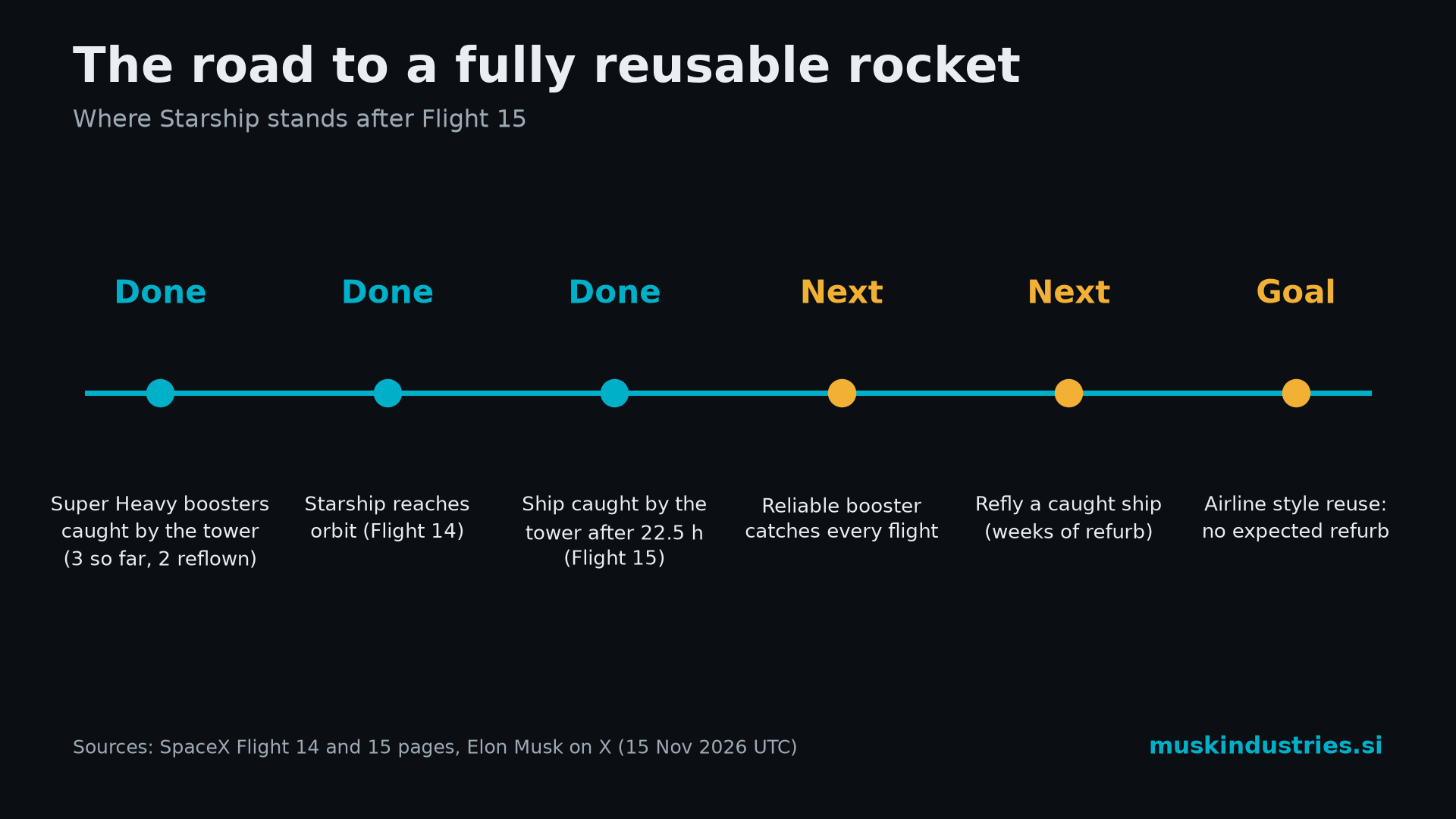
Short answer: On Flight 15, SpaceX flew a Starship to orbit, deployed 26 Starlink V3 satellites, spent more than 20 hours in space, then brought the ship back to the pad it launched from and caught it with the launch tower arms for the first time. A rocket stage that comes home in one piece can fly again, and Elon Musk says this ship could probably be reflown after a few weeks of refurbishment.
Why it matters
Most rockets are thrown away after one flight. That is like flying a jet across the ocean and scrapping it on arrival. SpaceX calls recovering the entire launch vehicle “the holy grail of rocketry”, and until this weekend no Starship upper stage had ever been caught. Falcon 9 already lands and reuses its booster. Starship is designed to reuse both stages, which is what could make very large, very frequent launches affordable: more Starlink capacity, Moon landings and, later, cargo to Mars.
How it works
The launch. Flight 15 lifted off from Pad 2 at Starbase, Texas, on Friday 13 November 2026 (US time), powered by 33 Raptor engines. After hot staging, the ship carried on to space on six Raptors and fired one engine to enter an orbit about 275 kilometers up.
The coast. Starship released 26 Starlink V3 satellites over about 42 minutes, and SpaceX made contact with every one. The ship then circled Earth for more than 20 hours while flight controllers checked its systems and heatshield.
The catch. On Saturday 14 November, Starship relit one Raptor for its deorbit burn, came back through the atmosphere, flew back to the Texas coast and lit three engines for a landing flip. The tower arms, nicknamed Mechzilla, closed around it 22.5 hours after it had left the same site.
What’s real now
- The ship is back and in good shape: after inspecting it, Musk wrote on X that the heatshield and engines “look great” and that Ship 42 “could probably be reflown with a few weeks of refurbishment”.
- Not airline style yet: in the same post he said many small fixes are still needed for immediate reuse “like an airplane”, meaning no expected refurbishment apart from scheduled maintenance.
- The booster splashed down this time: Super Heavy’s boostback burn ended early on low fuel, with the root cause under investigation. Its computers aborted the catch and diverted it to a planned offshore landing burn over the Gulf. SpaceX has caught three earlier boosters with the tower and flown two of them again. See Why does SpaceX catch boosters with chopsticks?
- The cargo did its job: all 26 Starlink V3 satellites are in orbit and raising themselves into the constellation.
Numbers
| Flight 15 | Figure |
|---|---|
| Raptor engines at liftoff | 33 on the booster, 6 on the ship |
| Orbit height | About 275 km |
| Starlink V3 satellites deployed | 26 |
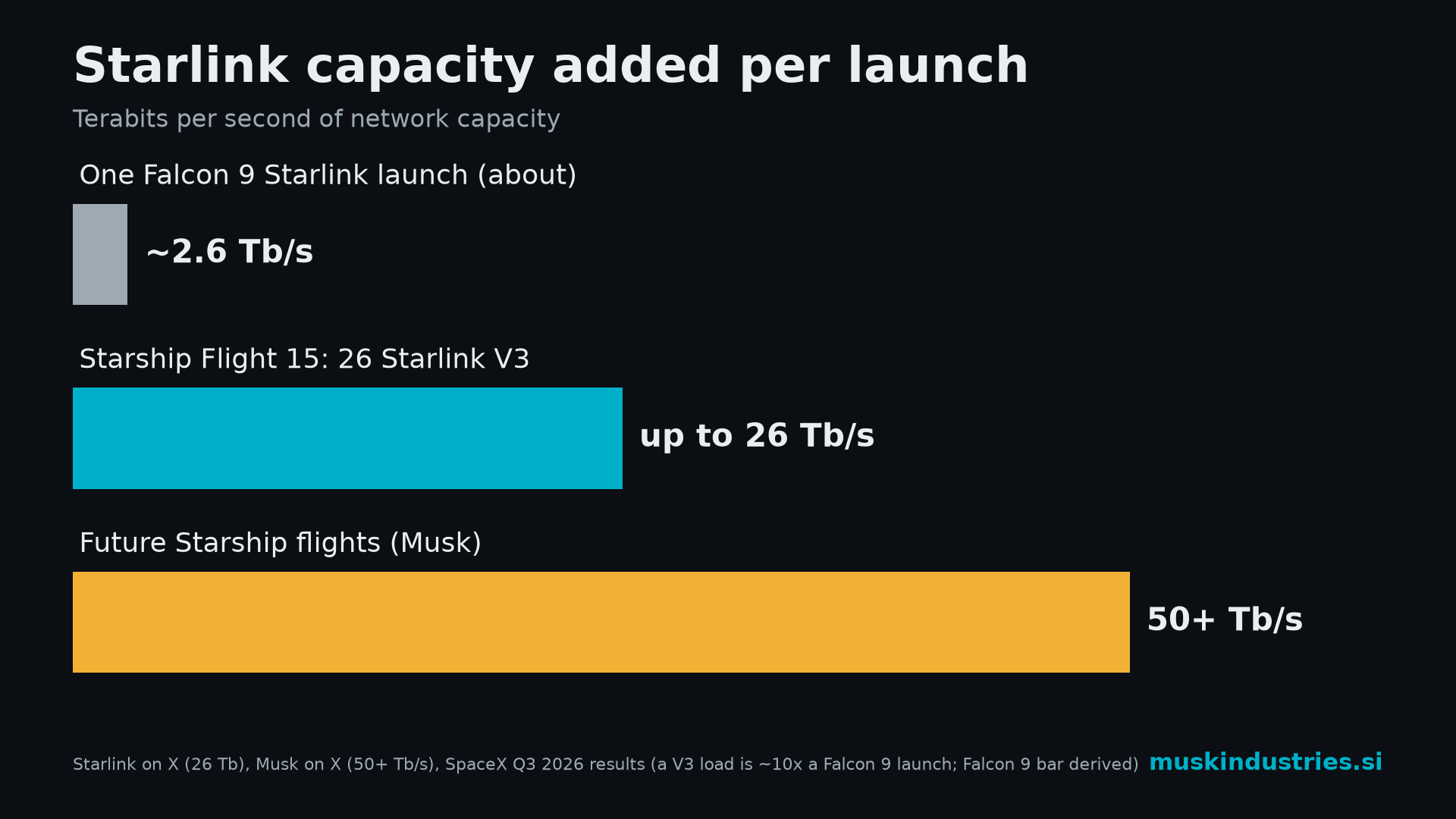
| Starlink capacity added | Up to 26 terabits per second |
| Time in space | More than 20 hours |
| Liftoff to catch | 22.5 hours, same launch site |
| Engines for the landing flip | 3, throttling down to 1 at the catch |
Each Starship Starlink load is about ten times the downlink capacity added by a Falcon 9 Starlink launch, according to SpaceX’s third quarter results, and Musk says future flights will carry more than 50 terabits per second.
What’s next
- Refly a caught ship: the next proof is flying Ship 42, or another caught ship, again. Musk’s estimate is a few weeks of refurbishment for this one.
- Catch both stages on one flight: Flight 15 aimed to catch the booster and the ship. The ship part is done; the booster part waits on the boostback investigation.
- Refuelling in orbit: reusable ships are what make ship to ship refuelling practical, the step SpaceX needs for the Moon and for Mars cargo. See How much does it cost to send cargo to Mars on Starship?
- Track the promises: Musk’s Starship and Mars dates live on the Musk Timeline Tracker. For Tesla’s self driving side, see How many Tesla Cybercabs are on the road?
Before the flight we explained the plan in Can SpaceX catch a whole Starship? We will update this page when a caught ship flies again.
Sources
- SpaceX: Starship Flight 15: launch, orbit, 26 Starlink V3, booster diversion and investigation, ship return and first catch, flight timeline. Primary, read 16 November 2026.
- SpaceX on X: recovering the entire launch vehicle is “the holy grail of rocketry”. SpaceX on X: all 26 Starlink V3 satellites in orbit.
- Starlink on X: payload adds up to 26 terabits of capacity.
- Elon Musk on X, 15 November 2026 (UTC): heatshield and engines look great, Ship 42 could be reflown with a few weeks of refurbishment, immediate reuse still needs fixes. Elon Musk on X: future flights will carry over 50 Tb/s.
- SpaceX Reports Third Quarter 2026 Results: 26 Starlink V3 equal about 10x the downlink capacity of a Falcon 9 Starlink launch. Primary.
Top image and charts: Musk Industries originals from SpaceX’s published figures.
Musk Industries is an independent archive, not affiliated with SpaceX, Tesla, Elon Musk or related companies.