
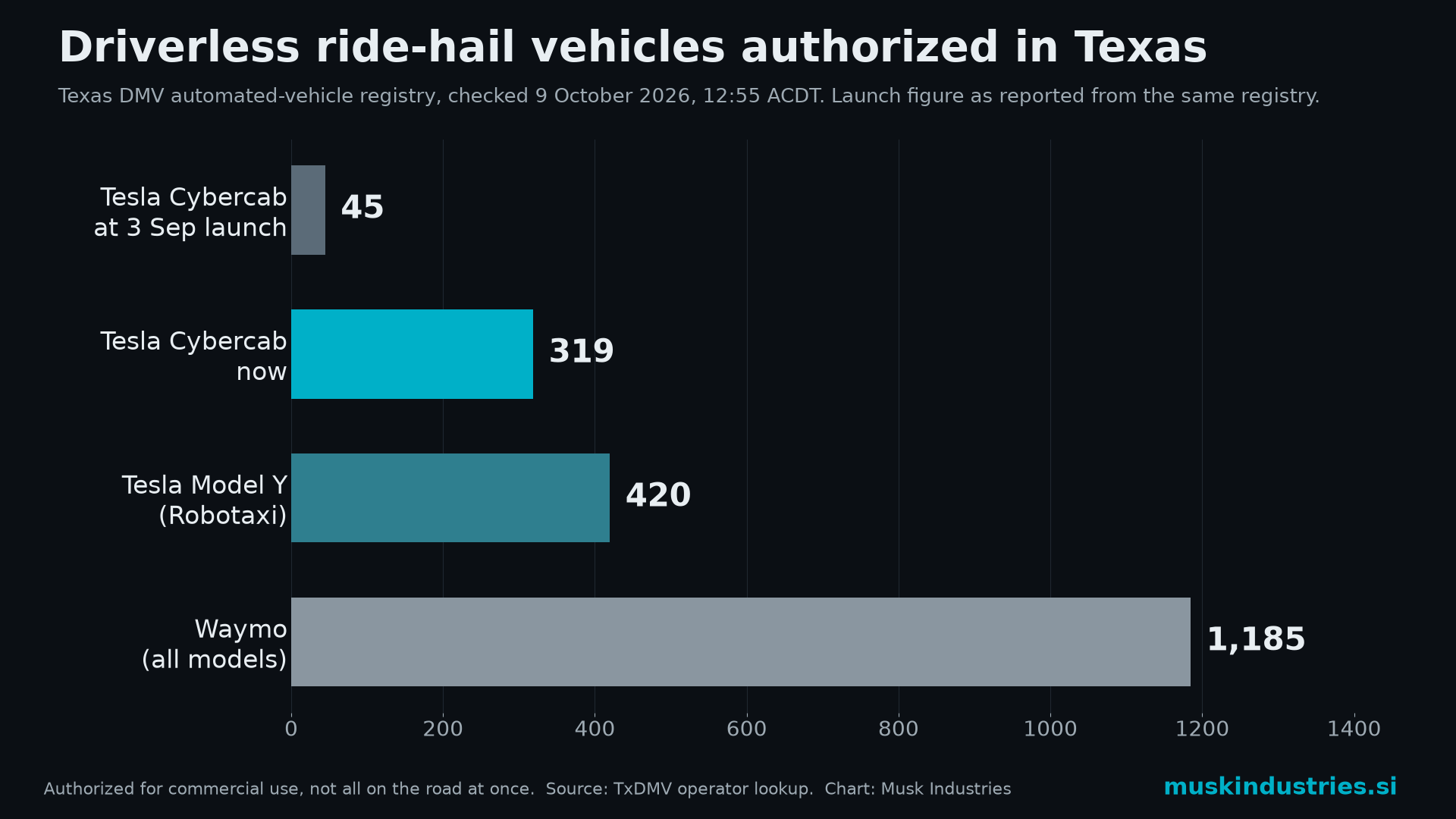
Short answer: 319. That is how many Tesla Cybercabs Texas lists as authorized for driverless ride-hail service, checked 9 October 2026, up from 45 at the 3 September Austin launch. Austin is still the only city with paid Cybercab rides. Tesla’s Texas robotaxi fleet also includes 420 Model Ys. Authorized is not the same as all on the road at once, and Tesla has not published its own Cybercab count.
Why it matters
The Cybercab is the first Tesla built with no steering wheel and no pedals. It only makes sense if the car drives itself, so the number of them carrying paying riders is the cleanest public scoreboard for whether Tesla’s self-driving plan is turning into a real transport service. The count has grown about sevenfold since the September launch. It is also still small next to the more established robotaxi fleet in the same state, which is why the number is worth checking rather than guessing.
How it works
Since a 2025 Texas law, any company running driverless vehicles commercially in the state needs an authorization from the Texas Department of Motor Vehicles (TxDMV), and each vehicle it runs is listed against that authorization. The list is public. Tesla’s operating company, Tesla Robotaxi, LLC, was authorized on 14 May 2026. Anyone can look up its vehicles by VIN in the TxDMV operator lookup, which is where the 319 comes from. Musk Industries last pulled the full list on 9 October 2026 (Adelaide time, which is the late evening of 8 October in Texas): 739 vehicles, of which 319 are 2026 Cybercabs and 420 are 2026 Model Ys.
That list tells you what Tesla is allowed to run, not what is moving right now. A listed car could be carrying a rider, charging, being cleaned, or waiting for a wider service area. Tesla does not publish a live count of Cybercabs in service, and its 2 October third-quarter deliveries release does not break Cybercab out at all.
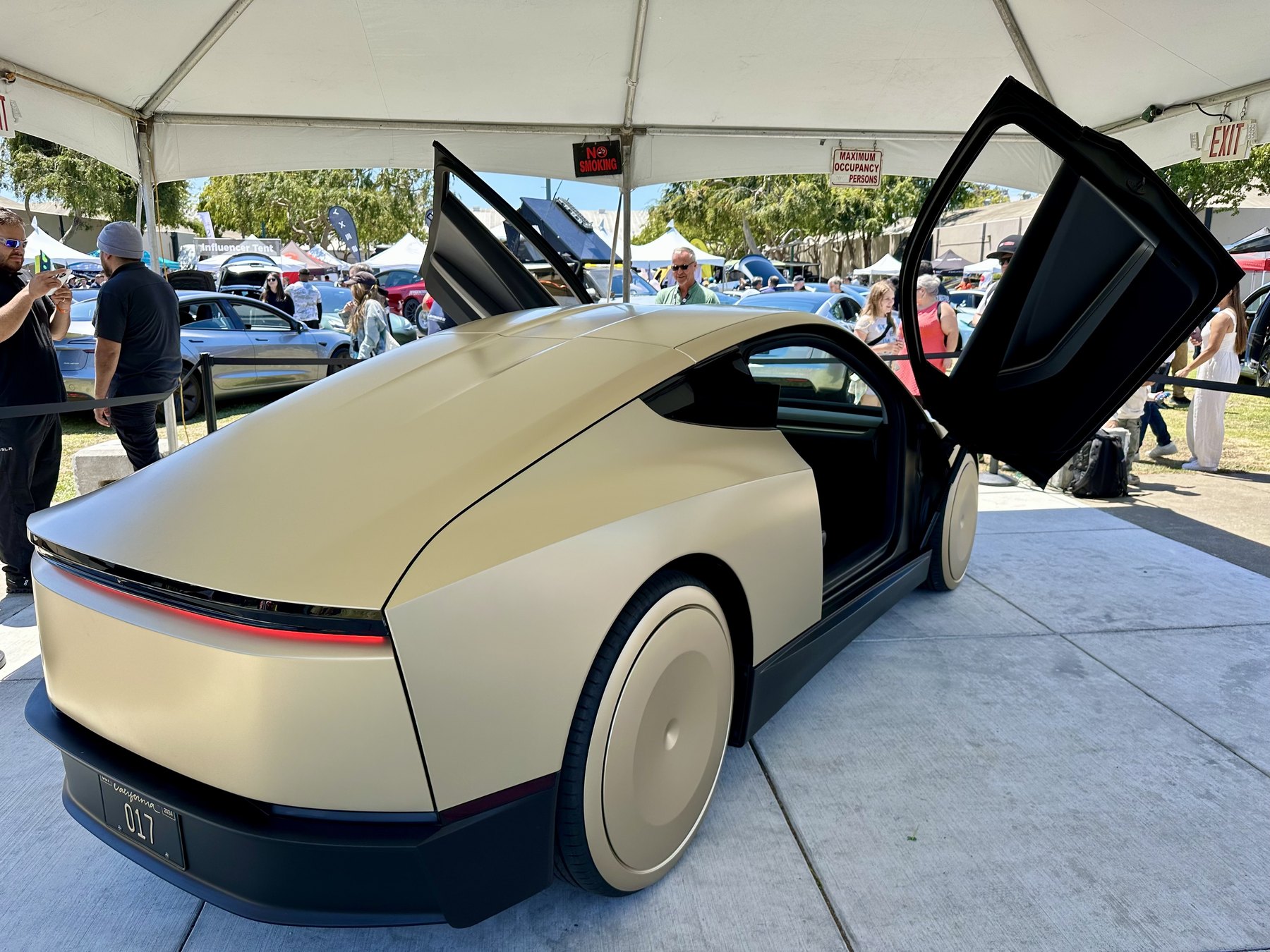
The car itself is a two-seater with a large centre screen and no steering wheel, pedals, side mirrors, or outside door handles. You book it in the same Tesla Robotaxi app used for the driverless Model Ys, the doors open from the app, and the screen shows a live 3D view of what the car sees, plus music and video apps for the ride. It runs on the same Full Self-Driving software as the rest of Tesla’s robotaxi fleet. With no controls inside, there is no one in the car who can take over.
What’s real now
- Production: Tesla’s second-quarter 2026 update says Cybercab production began at Gigafactory Texas, engineering test drives of production Cybercabs started on public roads, and employee rides began on the factory campus in July. The same update lists installed capacity of more than 125,000 Cybercabs a year at Gigafactory Texas, with Tesla’s own note that installed capacity is not the current production rate.
- Public rides: Tesla began Cybercab rides in limited areas of Austin on 3 September 2026, and paid public rides followed. A Verge reporter who rode it described a geofence of roughly 288 square miles and fares of about $15 to $21 across three trips.
- Fleet growth: 45 Cybercabs were registered at launch, as reported by The Verge and CNBC from the TxDMV list. It was 169 when we checked on 8 October and 319 on 9 October, so the listed Cybercab fleet nearly doubled in a day.
- Where: Austin is the only city with Cybercab service so far. Cybercabs have been spotted in Orlando and outside Miami International Airport, which is not the same as service there.
- Safety record so far: CNBC reported no significant safety incidents or collisions involving a Cybercab in Austin since the commercial debut. Early rider complaints were about wait times of 45 minutes or more, awkward pickup and drop-off spots, and the doors. One regular rider told CNBC waits have come down as demand evened out.
- The wider Tesla robotaxi network: separate from Cybercab, Tesla’s Q2 update lists its Model Y robotaxi service as ramping unsupervised in Austin, Dallas, Houston, Miami, Orlando, and Tampa, with a safety driver in the San Francisco Bay Area and preparations under way in Phoenix and Las Vegas.
How it compares
Waymo is the honest yardstick, because it runs in the same state under the same rules. On the same TxDMV list we checked, Waymo LLC has 1,185 vehicles authorized in Texas: 812 Jaguar I-PACEs and 373 Zeekr-built vehicles, the model Waymo calls Ojai. Waymo has been doing commercial driverless rides for years and runs around the clock. Tesla’s edge is the vehicle: a purpose-built two-seater it makes on its own line, at a factory it says can build more than 125,000 a year. All told, Tesla has 739 robotaxi vehicles authorized in Texas, a little over three-fifths of Waymo’s count there.
What’s next
- NHTSA review: the National Highway Traffic Safety Administration opened an audit query after launch into how Tesla self-certified that a car without a steering wheel or pedals meets federal safety standards. Tesla’s response was due 30 September; an agency spokesperson told CNBC that Tesla got an extension. Zoox, whose vehicles also lack manual controls, went through a similar review and received a formal exemption.
- 21 October 2026: Tesla’s third-quarter results. That is the next primary place Tesla could give a Cybercab production or fleet number of its own.
- More cities: CNBC reports the next step is Cybercab expansion across Texas, including San Antonio and Dallas, then Nevada and Florida. Tesla has not published dates.
We will update the count in place as the Texas list changes.
Sources
- TxDMV operator lookup: Tesla Robotaxi, LLC automated motor vehicles — authorization AV8313426653583 (14 May 2026); 739 vehicles, 319 Cybercab and 420 Model Y, checked 9 October 2026.
- Automated Vehicles Regulatory Program (TxDMV) — why commercial driverless operators must be authorized in Texas, and where the public lookup lives.
- Q2 2026 Update (Tesla) — Cybercab production start, public-road test drives, July employee rides, more than 125,000 installed capacity, and the robotaxi metro status table.
- Tesla third quarter 2026 production, deliveries and deployments (2 October 2026) — no Cybercab breakout; results date 21 October 2026.
- Reuters: Tesla starts Cybercab rides in Austin (3 September 2026) — secondary; Tesla’s “limited areas of Austin” statement and NHTSA’s response.
- The Verge: an hour riding in the Cybercab (9 September 2026) — secondary; first-hand ride, geofence size, fares, the 45 launch registrations, NHTSA audit query.
- CNBC: the Cybercab’s first month in Austin (3 October 2026) — secondary; rider experience, no significant incidents reported, NHTSA extension, expansion plans.
Top image: a Tesla Cybercab on Interstate 280 near Palo Alto, California, 19 September 2026. Photo: Daniel Lu (User:dllu) / Wikimedia Commons, CC BY-SA 4.0, cropped to 16:9.
Musk Industries is an independent archive — not affiliated with Tesla, SpaceX, Elon Musk, or related companies.