
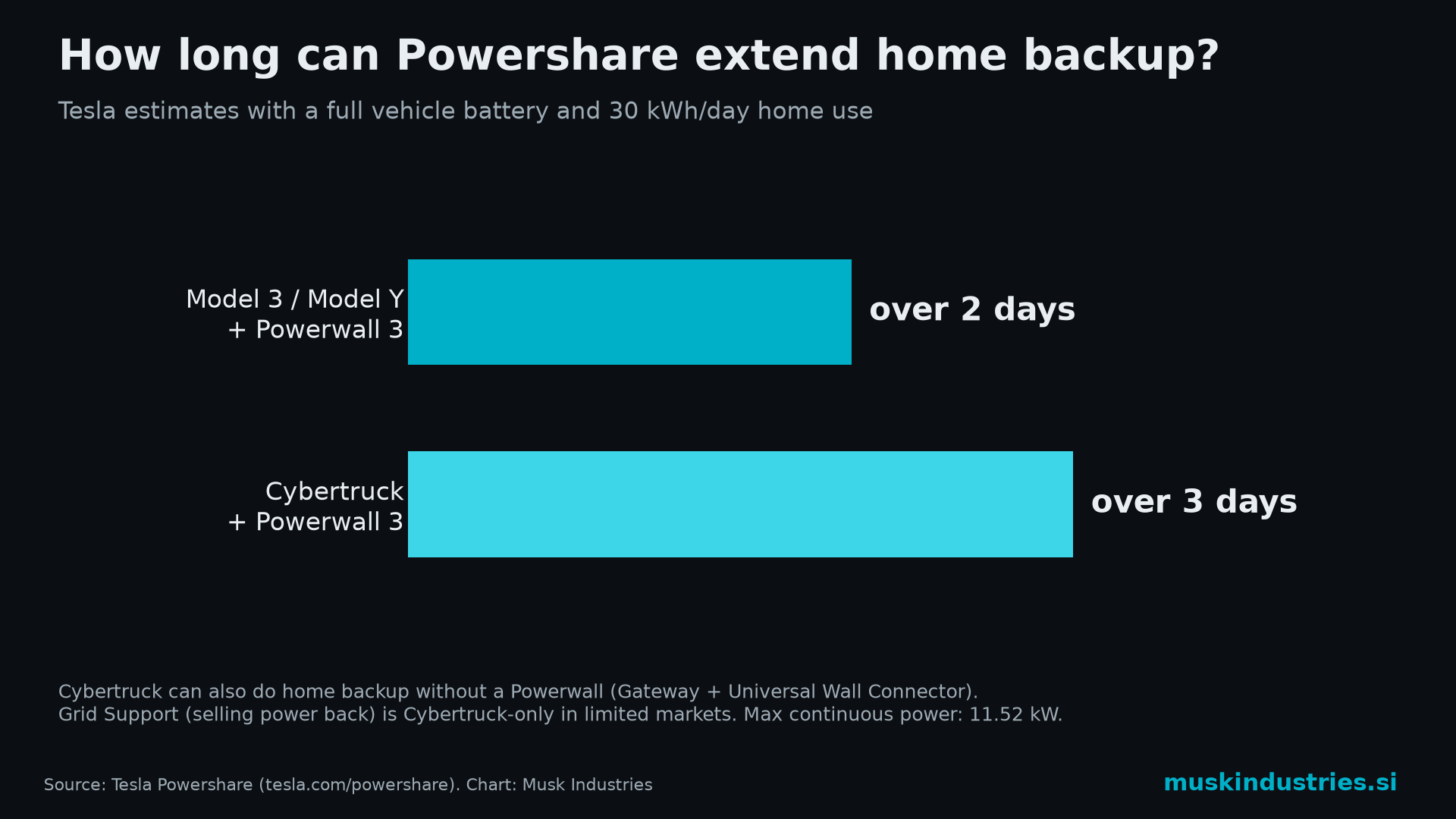
Short answer: Yes, if it is a Powershare-capable Tesla plugged into the right home gear. With Powerwall 3 and a Wall Connector, new Model 3 and Model Y vehicles ordered on or after 1 October 2026 in the US and Puerto Rico can extend home backup by over 2 days. Cybertruck can extend it by over 3 days, and Cybertruck can also do home backup without a Powerwall via a Powershare Gateway. Grid Support, which sells power back to the grid, is Cybertruck-only in limited markets.
Why it matters
When the lights go out, most homes wait on the utility. A small number already have a Powerwall that can cover hours or a day or two. Powershare Home Backup turns a plugged-in Tesla into extra stored energy for the same house, so the backup lasts longer without a generator.
That is useful in storm regions and anywhere grid reliability is thin. It also shows vehicle batteries doing more than driving: the same pack that moves the car can keep the fridge, lights and internet running while the grid is down.
How it works
Powershare is Tesla’s name for drawing power from a compatible vehicle battery to run devices, the home, or the grid. For home backup, the car plugs into a Wall Connector or Universal Wall Connector. When the grid fails, the system detects the outage and the vehicle supplies power into the home.
There are two install paths:
- With Powerwall 3: a compatible Model 3, Model Y or Cybertruck plus Powerwall 3 and a Wall Connector (or Universal Wall Connector). No Powershare Gateway is needed. The vehicle extends how long the Powerwall can keep the home running.
- Without Powerwall: Cybertruck only, using a Universal Wall Connector and a Powershare Gateway. Optional Backup Switch. Fully charged, Tesla says Cybertruck can power a home for over three days.
Both setups share the same headline power figure: up to 11.52 kW of continuous real power at 240 V AC. Bidirectional inverter hardware is PCS2 on Cybertruck and PCS2 Lite on Model 3 and Model Y, certified to UL1741 CRD.

What’s real now
- Live for new Model 3 and Model Y: Tesla Energy announced Powershare Home Backup for new Model 3 and Model Y with Powerwall 3 on 6 October 2026 (US). Tesla says all new Model 3 and Model Y ordered in the US and Puerto Rico on or after 1 October 2026 are capable. Some earlier vehicles are too; check on the car under Software, then Additional Vehicle Info, for Powershare Support.
- Cybertruck already covered: Powershare is available for all Cybertruck vehicles. Home backup works with Powerwall 3, or without a Powerwall via Gateway hardware.
- Grid Support is narrower: selling excess energy back to the grid is available for Cybertruck in limited markets only. It is not available for Model 3 or Model Y.
- Powerwall 2 and Powerwall+: Tesla says compatibility is coming soon, enabled by over-the-air update once ready. Today’s Powerwall path is Powerwall 3.
- Cost without Powerwall: Tesla says installation without a Powerwall typically ranges from about $2,000 to $4,000 USD, depending on the home. Hardware typically costs about $1,950 USD, or less if some equipment is already installed. Using built-in vehicle outlets to power tools and appliances needs no extra home hardware.
Numbers
| Item | Figure | Source |
|---|---|---|
| Max continuous real power (both setups) | 11.52 kW | Tesla Powershare |
| Nominal voltage | 240 V AC | Tesla Powershare |
| Model 3 / Model Y backup extension with Powerwall 3 | over 2 days | Tesla Powershare; Tesla Energy on X |
| Cybertruck backup extension with Powerwall 3 | over 3 days | Tesla Powershare |
| Cybertruck home backup alone (no Powerwall) | over 3 days | Tesla Powershare |
| Assumed home use for duration estimates | 30 kWh per day, full vehicle battery | Tesla Powershare |
| Model 3 / Model Y eligibility (new orders) | US and Puerto Rico, ordered on or after 1 October 2026 | Tesla Powershare |
| Grid Support | Cybertruck, limited markets; not Model 3 or Model Y | Tesla Powershare |
| Install without Powerwall (typical) | about $2,000 to $4,000 USD | Tesla Powershare |
| Powershare hardware (typical) | about $1,950 USD | Tesla Powershare |
| Safety certification | UL1741 CRD (PCS2 / PCS2 Lite) | Tesla Powershare |
What’s next
- Powerwall 2 and Powerwall+: Tesla lists support as coming soon, then enabled by over-the-air update.
- Older Model 3 and Model Y: some pre-1 October 2026 vehicles are already capable; owners can confirm on the touchscreen. Broader retrofit clarity may still expand.
- Grid Support markets: still Cybertruck-only and limited. Watch for more regions, and any future Model 3 or Model Y Grid Support (none today).
- Done, 21 October 2026 (US): the Tesla Q3 2026 Update lists more than 6 GWh a year of Powerwall production capacity in Nevada. It does not give a separate Powerwall deployment number.
We will update this page in place when Powerwall 2 or Powerwall+ support goes live, when Grid Support expands, when older-vehicle capability is clarified further, or when Tesla publishes new Energy numbers.
Sources
- Tesla Powershare product page: Home Backup with and without Powerwall, vehicle compatibility, 11.52 kW specs, duration estimates, cost ranges, Grid Support limits, certifications, FAQ.
- Tesla Energy on X, 6 October 2026 (US): Powershare Home Backup now available for new Model 3 and Model Y with Powerwall 3; extend home backup by over 2 days.
- Tesla Energy on X, 13 October 2026 (US): Powershare Home Backup extends outage protection by 2+ days; available for new Model 3/Y and Cybertruck with Powerwall 3.
- Tesla Energy on X, 6 October 2026 (US): how to check vehicle Powershare capability under Software settings.
Top image: Raysonho @ Open Grid Scheduler / Scalable Grid Engine, Tesla Model 3 at a destination charger, CC0 via Wikimedia Commons; cropped to 16:9. Illustrative charging photo, not a Powershare Home Backup install.
Musk Industries is an independent archive, not affiliated with Tesla, SpaceX, Elon Musk or related companies.