
Short answer: Tesla is plugging new Superchargers into the grid before the local power upgrades are finished. Through PG&E’s Flex Connect program in California, a site runs at full power whenever the grid has room and steps down only in the few busy hours the utility flags a day ahead. Tesla expects a typical project to open more than 2 years sooner, and as of October 2026 its V4 Supercharger cabinets talk to PG&E’s systems directly.
Why it matters
Building a Supercharger is the quick part. Getting enough power to it can take years. Tesla says that in Southern California, Megacharger projects for the Tesla Semi can wait more than 3 years in the utility queue for power. That wait has nothing to do with chargers or construction crews. It is the time it takes a utility to upgrade transformers and lines.
A common worry is that fast chargers will overload the grid. This shows the real picture is more useful than that. The grid is sized for its busiest hours, so most of the time it has spare room. A charger that can politely step back during those few peak hours can use that spare room now, instead of waiting for upgrades that only matter at the peak.
How it works
When a new site asks for more power than the local grid can always guarantee, PG&E issues a load limit letter. It says how much power is guaranteed today and roughly when the upgrades will be done. Normally the site is held to that guaranteed figure, all year, until the work is finished.
Flex Connect changes that. PG&E’s grid management software forecasts how loaded its local equipment will be, then sends the site an hourly power limit for the next day, by 8am the day before. The site’s own system follows that schedule and reports its actual power use back within 30 seconds. If the link drops for more than 15 minutes, the site falls back to the safe guaranteed limit. Both sides speak IEEE 2030.5, an open standard California already requires for smart inverters connected to its big utilities.
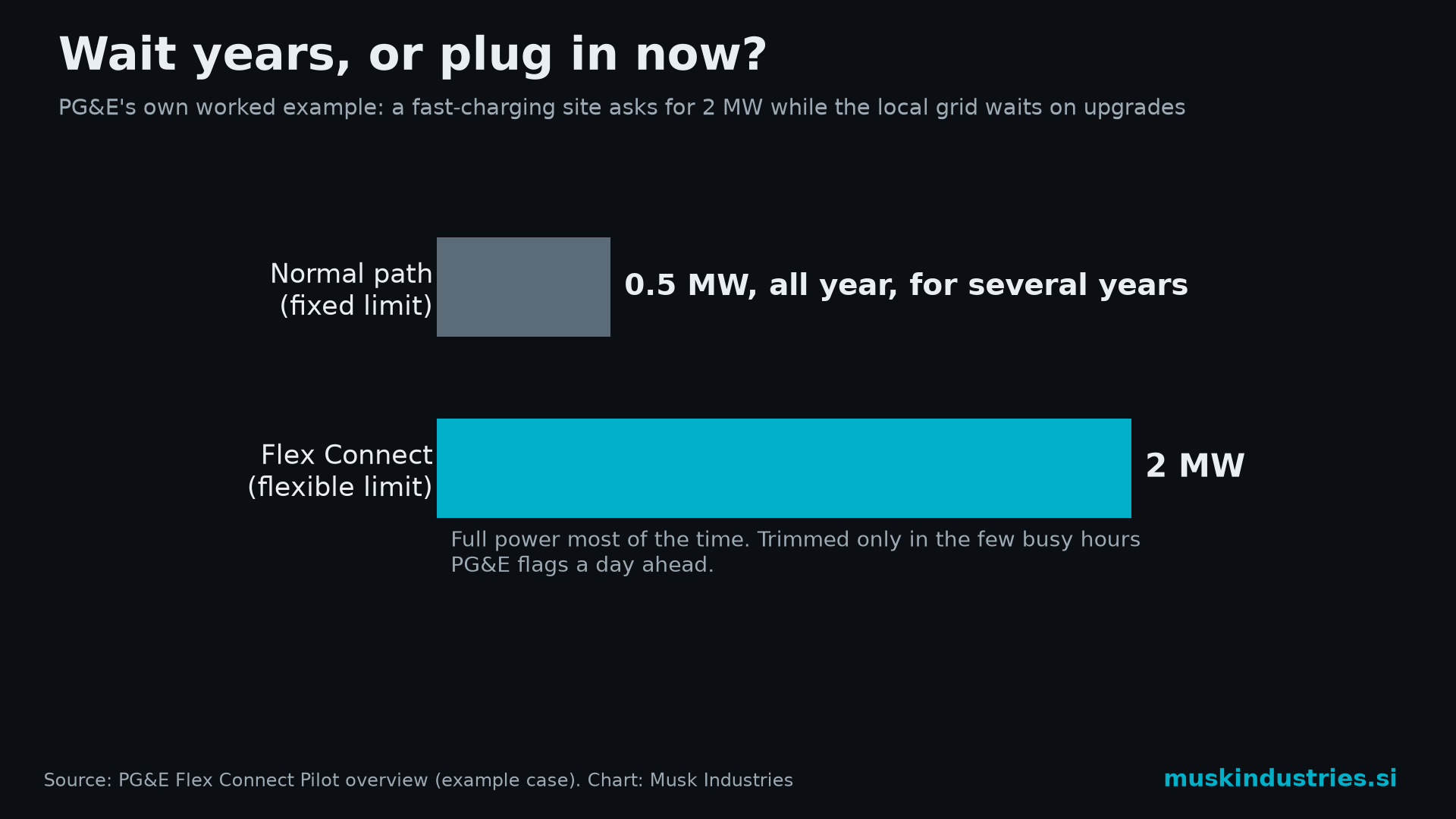
PG&E’s own worked example makes the gain plain. A fast-charging site asks for 2 MW. The grid can handle 2 MW most of the year, but a small number of peak hours means the normal path caps it at 0.5 MW for years. On Flex Connect, the same site gets the full 2 MW right away, most of the time.
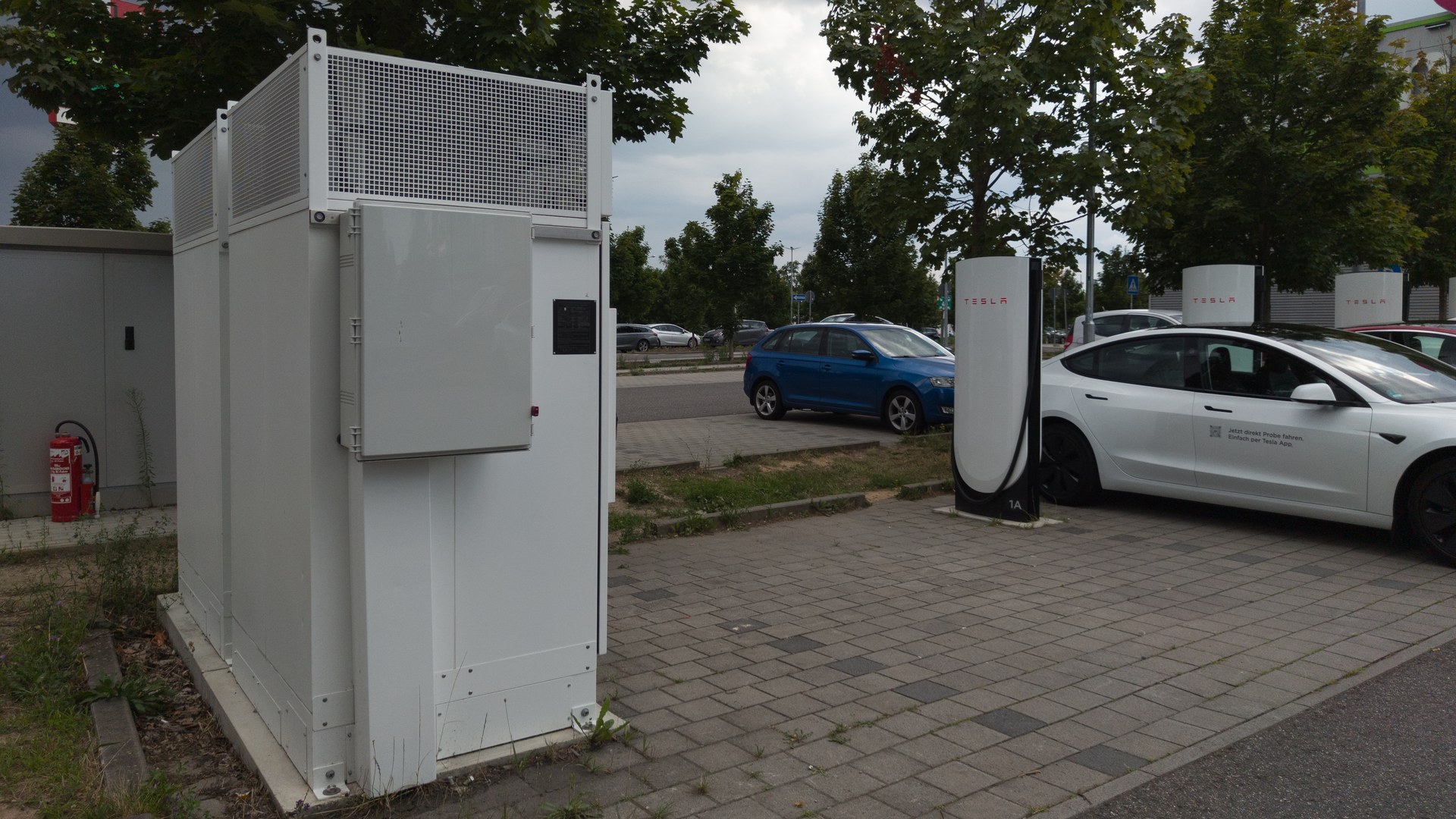
Tesla’s side of the deal is the hardware. The power cabinet at each site is what turns a grid limit into charging speed. Tesla says its V4 cabinets can now receive PG&E’s day-ahead limits directly, so a site can be turned down a little when the grid is tight and run flat out when it is not. Tesla adds that drivers shouldn’t notice, especially early on, because new sites typically run well below their maximum.
What’s real now
- Already working: Tesla says Flex Connect has already sped up some existing Supercharger projects, with dozens more underway.
- Direct link live: as of October 2026, V4 Supercharger cabinets talk to PG&E’s systems over IEEE 2030.5, and PG&E can set each site’s power limit from day-ahead forecasts.
- Pilot sites: several pilot sites are scheduled to open this October, followed by a wider rollout across Northern California.
- Open program: Flex Connect isn’t Tesla only. PG&E runs it for any eligible customer whose upgrades will take more than 12 months and whose load can follow a schedule, usually one site per feeder.
- Tesla’s pitch to utilities: say clearly how much capacity exists and when upgrades finish, start with simple seasonal limits if advanced monitoring isn’t ready, and standardise on IEEE 2030.5. Tesla calls a flexible connection “a bridge, not a permanent solution.”
Numbers

| Item | Figure | Source |
|---|---|---|
| Supercharger stations (end of Q3 2026) | 8,904, up 15% in a year | Tesla Q3 2026 Update |
| Supercharger connectors (end of Q3 2026) | 84,465, up 14% in a year | Tesla Q3 2026 Update |
| Net new stalls in Q2 2026 | over 2,400 | Tesla Q2 2026 Update |
| Network on 2 Oct 2026 | 85,000+ stalls, 9,000+ sites | Tesla Charging on X |
| Megacharger wait for power, Southern California | 3+ years in some cases | Tesla Charging on X |
| Expected head start with a flexible connection | more than 2 years for a typical project | Tesla Charging on X |
| PG&E limit schedule | hourly, sent a day ahead (up to 3.5 days) | PG&E fact sheet |
| PG&E example site | 2 MW most of the time vs 0.5 MW fixed | PG&E pilot overview |
What’s next
- October 2026: the first PG&E pilot sites using the direct V4 link are due to open.
- After the pilots: a wider rollout across Northern California, according to Tesla.
- Done, 21 October 2026 (US): the Tesla Q3 2026 Update put the network at 8,904 stations and 84,465 connectors at the end of September, and said Tesla deployed its first factory pre-assembled Accordion Supercharger and its first pre-assembled Megacharger for the Semi.
- Beyond California: Tesla is asking utilities worldwide to adopt IEEE 2030.5 so the same approach can work elsewhere, including for megawatt Semi charging.
We will update this page in place when the pilot sites open, when another utility signs on, or when Tesla publishes new network numbers.
Sources
- Opening Superchargers Years Sooner (Tesla Charging article on X, 12 Oct 2026 US): grid capacity bottleneck, 3+ year Megacharger waits in Southern California, how flexible connections work, PG&E Flex Connect results, more than 2 years sooner, V4 cabinets on IEEE 2030.5, October pilot sites, principles for utilities.
- Tesla Charging on X, 2 Oct 2026: 85,000+ stalls and 9,000+ sites.
- Tesla Q2 2026 Update: stations and connectors by quarter, over 2,400 net new stalls.
- Tesla Q3 2026 Update: 8,904 stations and 84,465 connectors at 30 September 2026.
- PG&E Flex Connect Pilot overview: eligibility, 12 month threshold, 2 MW vs 0.5 MW example.
- PG&E Flex Connect fact sheet for EV DC fast charging: load limit letters, hourly limits 24 hours ahead (up to 3.5 days), 8am deadline, one site per feeder, IEEE 2030.5.
- PG&E technical requirements for telemetry and control: 30 second telemetry, fallback limits, California Rule 21 and IEEE 2030.5.
Top image: Tony Webster, Tesla Supercharger station in Colorado, CC BY 4.0 via Wikimedia Commons; cropped to 16:9. Illustrative V4 site, not a Flex Connect pilot site.
Musk Industries is an independent archive, not affiliated with Tesla, SpaceX, Elon Musk, PG&E or related companies.