
Short answer: Yes. On 28 September 2026, Starship Flight 14 became the first Starship to reach Earth orbit. It released 26 Starlink V3 internet satellites that stay up and will serve customers, then made Starship’s first deorbit burn and splashed down on target in the northern Pacific. An engine shut down on the way up, so SpaceX brought it home early. Every flight before this was suborbital on purpose.
Why it matters
Orbit is the gate to almost everything Starship is for. A rocket that only goes up and comes straight back down can test hardware, but it cannot leave satellites in space, refuel another ship, or head for the Moon. For its first 13 flights, SpaceX kept Starship just short of orbit on purpose. On Flight 13 in July, Starship released 20 Starlink V3 satellites that SpaceX expected to burn up about 20 minutes later. On Flight 14 the 26 satellites stayed up.
That changes what Starship is. SpaceX says each Starship launch of V3 satellites adds more than 20 times the network capacity of a Falcon 9 launch of today’s V2 satellites. Orbit is also where Starship has to prove in-space refuelling, the step that lets one ship carry up to 100 tonnes to the surface of the Moon for NASA’s Artemis program.
How it works
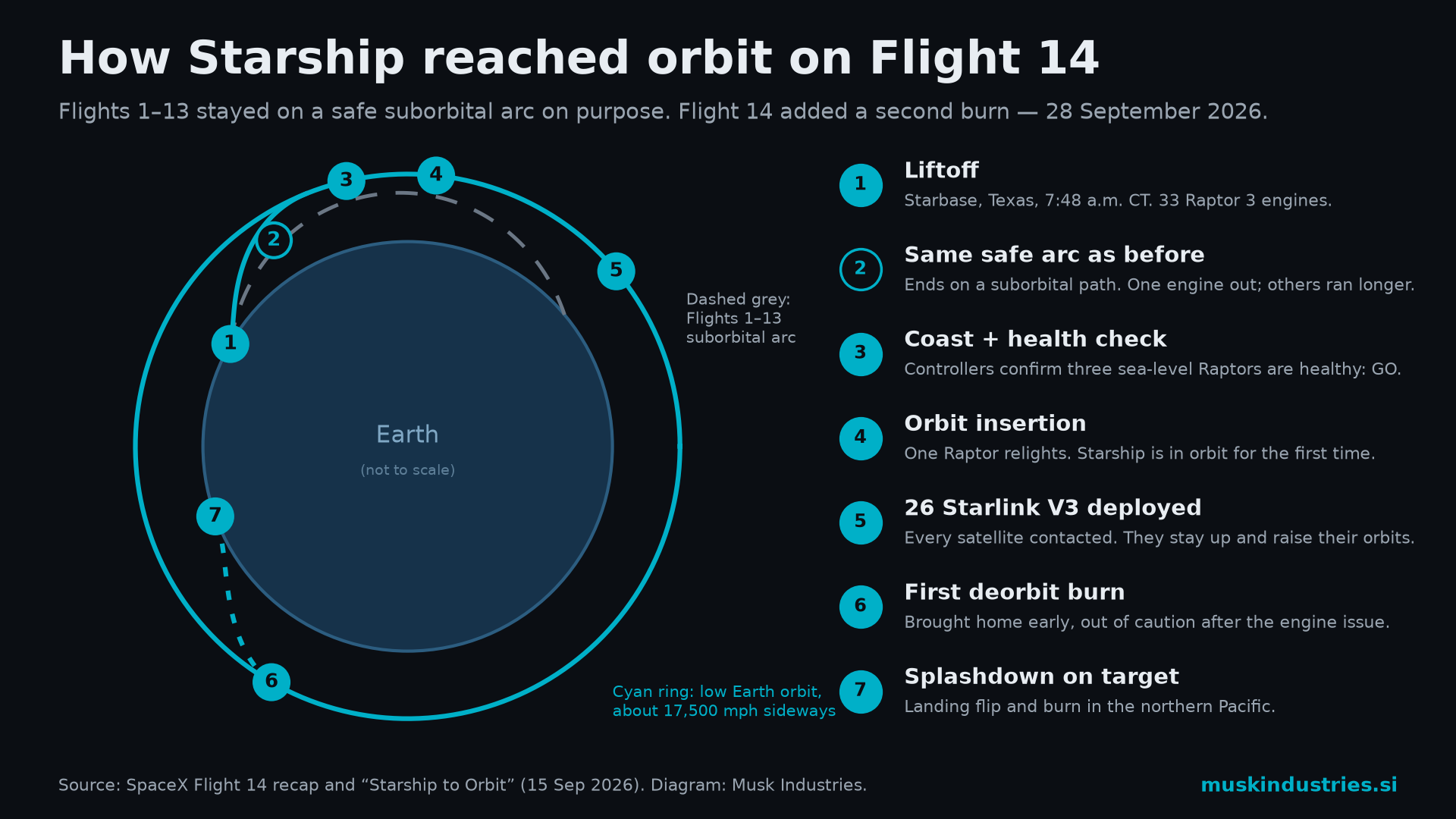
Getting to orbit is less about height and more about speed. SpaceX’s own explainer puts it simply: once you are high enough, you have to travel sideways at about 17,500 mph (28,000 km/h) in low Earth orbit, so that as gravity pulls you down, the Earth curves away underneath you at the same rate. You are falling the whole time, and you keep missing the ground.
Starship is two stages. The Super Heavy booster, with 33 Raptor engines burning liquid methane and liquid oxygen, does the first couple of minutes. The upper stage, the ship that is also called Starship, then lights its own six Raptors and carries on to space. SpaceX calls the hand-off “hot staging”: the ship lights its engines while it is still attached to the booster.
Earlier flights ended the ship’s main burn a little short of orbital speed. SpaceX calls that a “passively safe” suborbital path: even if the team lost all control, the ship was already falling toward a planned ocean splashdown zone. Flight 14 kept that safety net. The ship first went onto the same suborbital path, then coasted while controllers checked its health. They watch engine health, power, communications, flight computers, tank pressure and steering, fed by more than 500 sensors on the vehicle. Only after a “go” did the ship relight one Raptor to add the last bit of speed and enter orbit. Coming home works the same way in reverse: one Raptor fires to slow the ship down (the deorbit burn), and the atmosphere does the rest.
What’s real now
From SpaceX’s Flight 14 recap:
- Liftoff: 7:48 a.m. Central Time on Monday 28 September 2026, from Starbase, Texas, on all 33 Raptor 3 engines. One booster engine shut down during the climb.
- The booster: relit 31 of 33 engines to turn back. That burn was designed to use up the remaining liquid oxygen and test the booster’s limits before future flights that return to the launch site. It then splashed down in the Gulf.
- The ship: one of its vacuum engines (the Raptors built for space) shut down early. The other five burned longer to make up the difference and hit the planned path.
- Orbit: after the health check, one sea-level Raptor relit for the orbit insertion burn. Starship was in orbit for the first time.
- Payload: all 26 Starlink V3 satellites deployed. SpaceX made contact with every one over laser links, ground stations and Starlink user terminals. They will check out, raise their orbits, then start serving customers.
- Coming home: because of the engine issue on ascent, the team cut the time in orbit short. SpaceX’s pre-flight timeline had the deorbit burn almost nine hours after liftoff; Smithsonian reports the whole flight ended up lasting about three hours. Starship made its first-ever deorbit burn, survived reentry, relit three engines for a flip and landing burn, and splashed down on target in the northern Pacific, one of two zones cleared before launch.
| Flight | Date | Where the ship went | What it carried |
|---|---|---|---|
| 12 | 22 May 2026 | Suborbital, Indian Ocean splashdown | 20 Starlink simulators and 2 modified Starlinks that photographed Starship in space. First V3 vehicle. |
| 13 | 24 Jul 2026 | Suborbital, intact soft splashdown in the Indian Ocean | 20 Starlink V3 satellites, expected to burn up about 20 minutes after release |
| 14 | 28 Sep 2026 | Orbit, then deorbit to the northern Pacific | 26 Starlink V3 satellites, staying in orbit |
What’s next
- Flight 15: SpaceX has not announced a date or mission plan. Provisional planning documents reported by Space.com put the earliest launch at 19 October 2026. At the All-In Summit on 14 September, Elon Musk said SpaceX may try to catch the ship with the launch tower on Flight 15 if Flight 14 went well. No Starship upper stage has been caught yet; three Super Heavy boosters have (how the chopsticks work).
- The paperwork for coming home: the Federal Aviation Administration (FAA), which licenses US rocket launches, has completed an environmental review covering extra Pacific landing areas for Starship and an additional reentry path back to the launch site at Starbase. Bringing the ship back to Starbase is what a tower catch requires.
- Refuelling in space: SpaceX says orbital flights open the way to the first orbital propellant transfer. So far it has moved about five tonnes of propellant between tanks inside one ship; it has not yet moved fuel from one ship to another.
- Starlink V3 service: the 26 satellites from Flight 14 now have to finish checkouts and climb to their working orbits before customers use them.
We will update this page in place as the next flights happen.
Sources
- Starship Flight 14 (SpaceX) — liftoff time, engine-outs, orbit insertion, 26 Starlink V3 deployed, first deorbit burn, northern Pacific splashdown, pre-flight timeline.
- Starship to Orbit (SpaceX, 15 September 2026) — what orbit is, the 17,500 mph figure, passively safe suborbital flights, the health check, more than 500 sensors.
- Starship Flight 13 (SpaceX) and Flight 12 (SpaceX) — earlier V3 flights and their payloads.
- xAI joins SpaceX (SpaceX, 2 February 2026) — each Starship V3 launch adds more than 20 times the capacity of a Falcon V2 Starlink launch.
- To the Moon and Beyond (SpaceX, 30 October 2025) — about five tonnes of propellant moved between tanks, up to 100 tonnes to the lunar surface with refuelling.
- SpaceX Starship/Super Heavy at Boca Chica (FAA) — completed environmental review for Pacific landing areas and a reentry path back to Starbase.
- Space.com: Starship just reached orbit for the first time (29 September 2026) — secondary; Musk’s All-In Summit comment on a Flight 15 ship catch, provisional 19 October date.
- Smithsonian: Starship reached Earth orbit on its first try — secondary; flight length of about three hours.
Top image: Starship’s sixth flight lifting off from Starbase, Texas, seen from the International Space Station on 19 November 2024 (an earlier flight, not Flight 14). Photo: NASA/Don Pettit / Wikimedia Commons, public domain, cropped to 16:9.
Musk Industries is an independent archive — not affiliated with SpaceX, Tesla, Elon Musk, or related companies.