
Short answer: Terafab is a giant chip factory that SpaceX and Tesla plan to build in Grimes County, Texas, so they can make their own AI chips for Optimus robots, Cybercabs and data centres in space. The first phase is budgeted at about $16.8 billion and the goal is more than 1 terawatt of compute a year. A smaller research fab is being built in Austin; no Terafab chips exist yet.
Why it matters
Almost everything Musk’s companies are betting on runs on AI chips. Every Cybercab needs a computer to drive itself, every Optimus robot needs one to see and move, and xAI needs huge numbers of them to train and run Grok. Right now those chips come from outside chipmakers such as TSMC and Samsung, the same factories that make chips for much of the tech industry.
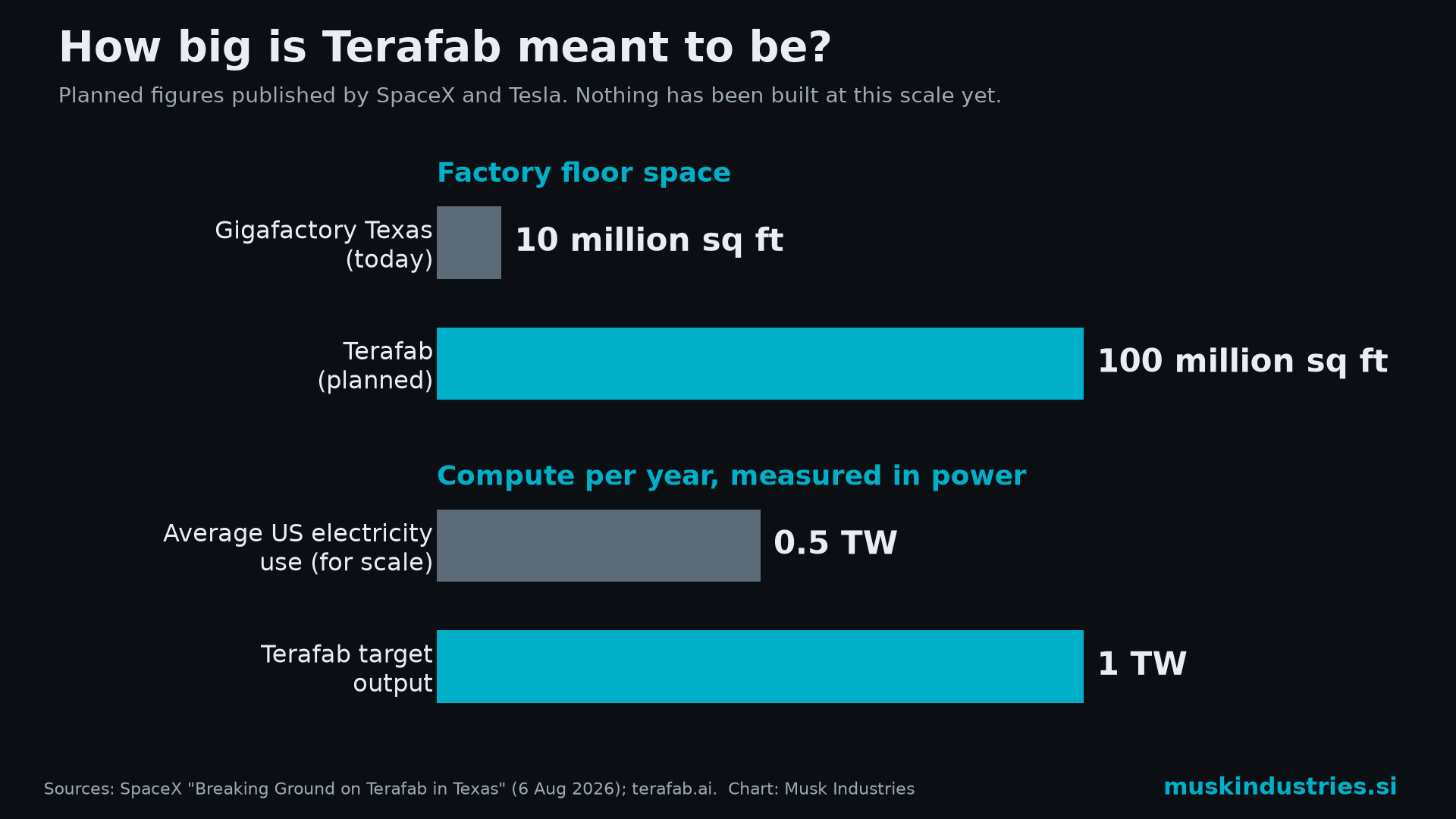
SpaceX and Tesla say their combined demand will be more than 1 terawatt (TW) of compute, which they call “significantly larger than the current global supply.” At the launch event in March, Musk put the world’s current output of AI chips at roughly 20 gigawatts a year, about 2% of what his companies expect to need. His line on it: “We either build the Terafab or we don’t have the chips.” Terafab is the plan to stop being limited by someone else’s factory.
How it works
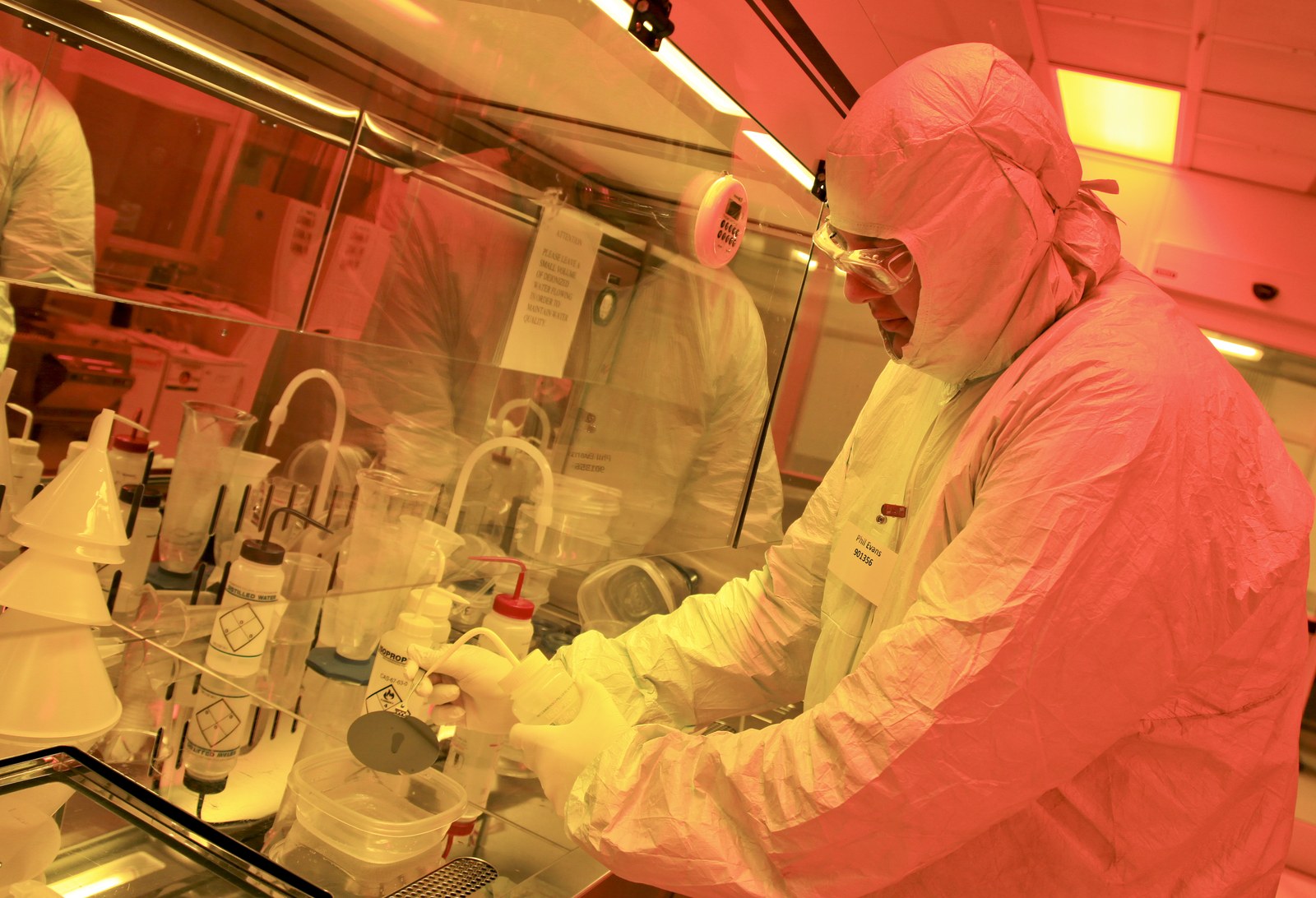
A chip fab turns plain silicon discs called wafers into finished chips. Inside dust-free clean rooms, machines print circuits onto the wafer with light, layer after layer, until each wafer holds hundreds of chips. The wafer is then cut up and each chip is tested and packaged so it can be wired into a car, robot or server.
Today those steps are usually split across different companies and countries. One company makes the logic chips (the processors that do the thinking), another makes the memory chips that hold the data, and a third does the advanced packaging that joins them into one module. Terafab’s pitch is to put all three under one roof. SpaceX says that will “enable fast, recursive improvements”: when the design team changes a chip, the whole chain can try it out without waiting on outside suppliers.
The “terawatt” goal is a way of counting chips by the power they draw when running. A terawatt is a trillion watts. Terafab’s own site compares its 1 TW a year target with average US electricity use of about 0.5 TW. Musk has said roughly 100 to 200 gigawatts a year would go into chips used on Earth, such as cars and robots, with most of the rest headed for solar-powered AI satellites.
The chips come in two families. Terafab’s site lists AI5 (for self-driving and Optimus), AI6 (for Optimus) and D3 (for space). SpaceX describes them as chips “optimized for edge computing and inference,” meaning running AI inside a car or robot, plus high-power chips for its space-based data centres.
What’s real now
- Announced: Musk launched Terafab on 21 March 2026 at an event in Austin as a joint project of Tesla, SpaceX and xAI. xAI has been part of SpaceX since February.
- Research fab under construction: Tesla broke ground in April on a research fab on the north campus of Gigafactory Texas, which SpaceX calls “the precursor to Terafab.” In its Q2 2026 update, Tesla said construction and equipment buying for that Austin fab were under way but still “in its early stages.”
- The big site is picked: on 6 August, SpaceX named Grimes County, Texas, about an hour northwest of Houston. The plan is more than 100 million square feet of factory, about ten times Gigafactory Texas, with at least 3,000 jobs. The site will use water from Gibbons Creek Reservoir rather than local groundwater.
- Partners: Intel said on 7 April that it had joined the project. On Tesla’s April earnings call, Musk said Terafab plans to use Intel’s 14A process, its next-generation manufacturing technology, once it matures. On 3 October, after a report that TSMC was exploring ways to work with Terafab, Musk confirmed talks on X: “Just discussions, but something may come of it.” On 7 October he drew the line in another X post: “No, we will build and run the fab. Let there be ZERO doubt about that. Maybe TSMC subleases part of the Terafab if they want, but nothing more than that.” So the most TSMC could get is rented space inside the building; SpaceX and Tesla plan to run the factory themselves. No TSMC agreement has been announced.
- Today’s chips still come from outside: Musk said in April that Tesla’s AI5 chip had been sent to both Samsung and TSMC for production. Samsung is preparing to make it at its fab in Taylor, Texas.
| Date | Milestone |
|---|---|
| 21 Mar 2026 | Terafab announced in Austin by Tesla, SpaceX and xAI |
| 7 Apr 2026 | Intel says it has joined the project |
| Apr 2026 | Tesla breaks ground on the research fab at Gigafactory Texas |
| 22 Apr 2026 | Musk says Terafab plans to use Intel’s 14A process |
| 6 Aug 2026 | Grimes County site named; first phase about $16.8 billion |
| 3 Oct 2026 | Musk confirms early talks with TSMC |
| 7 Oct 2026 | Musk says SpaceX and Tesla will build and run the fab; TSMC could at most sublease space |
What’s next
- Who builds it: Musk says SpaceX and Tesla will run Terafab themselves, with Intel’s 14A process planned once it matures. The open question is whether TSMC rents any space at all. Watch for a signed agreement or a statement from TSMC.
- Research fab progress: Tesla reports on its Austin fab in each quarterly update; the next one covers Q3 2026.
- Timelines: neither SpaceX nor Tesla has given a date for first chips from Terafab or for reaching the terawatt target.
- Where the space chips go: the high-power chips are meant for SpaceX’s planned AI satellites, which depend on Starship reaching orbit often and cheaply.
We will update this page in place as Terafab moves.
Sources
- Elon Musk on X (7 October 2026) — “we will build and run the fab”; TSMC at most subleases part of Terafab.
- Breaking Ground on Terafab in Texas (SpaceX, 6 August 2026) — Grimes County site, about $16.8 billion first phase, more than 100 million sq ft, at least 3,000 jobs, logic, memory and packaging under one roof, more than 1 TW of demand, research fab at Gigafactory Texas, reservoir water.
- Terafab (official site) — 1 TW a year target vs 0.5 TW average US use, 10 million vs 100 million sq ft comparison, AI5, AI6 and D3 chips.
- Tesla Q2 2026 Update (Tesla, 22 July 2026) — progress on construction and equipment buying for the Austin semiconductor fab, “still in its early stages.”
- KUT: Elon Musk announces chip manufacturing project in Austin (22 March 2026) — secondary; launch event and Tesla’s announcement post.
- Tom’s Hardware: Musk unveils Terafab (22 March 2026) — secondary; Musk’s livestream estimates of about 20 GW a year of global AI chip output and 100 to 200 GW a year for chips on Earth.
- Tom’s Hardware: Intel joins Terafab — secondary; quotes Intel’s statement.
- Tom’s Hardware: Terafab to use Intel 14A — secondary; Musk’s comments on Tesla’s April 2026 earnings call.
- Culpium: Elon Musk confirms TSMC-Terafab talks (3 October 2026) — secondary; the original TSMC report and Musk’s reply.
- Electrek: Samsung’s Texas fab and Tesla’s AI5 chip (13 July 2026) — secondary; AI5 sent to Samsung and TSMC, Samsung Taylor production plans.
Top image: close-up of a silicon wafer covered in chips (illustrative, not a Terafab wafer). Photo: Rob Bulmahn / Wikimedia Commons, CC BY 2.0, cropped to 16:9.
Musk Industries is an independent archive — not affiliated with SpaceX, Tesla, Elon Musk, or related companies.