
Short answer: The chopsticks are the launch tower’s arms. They catch Super Heavy so SpaceX can skip landing legs, return the booster to the same pad, and stack it again. Three catches are real — Flights 5, 7, and 8 (October 2024–March 2025). Flight 6 aborted to the Gulf. Later flights aimed boosters at the sea on purpose, and no Starship upper stage has been caught.
Why it matters
Falcon 9 already comes home. It lands on its own legs, on a drone ship or a ground pad, and flies again. Super Heavy is a different bargain. It is the first stage under Starship — 33 Raptor engines — and SpaceX’s plan for the Moon, Mars, and a high flight rate only works if that stage can fly, come back, and fly again without a recovery ship in the middle.
The tower is already the crane. It stacks the booster before launch. Catching it on the way down means the same arms can take it back and set it on the mount. In an October 2025 update, SpaceX tied “the launch, return, catch, and reuse” of that booster to the cadence it wants for lunar cargo. A July 2024 note put the same idea in plainer clothes: return the vehicles to the launch site and run the system more like an airplane than a one-shot rocket.
How it works
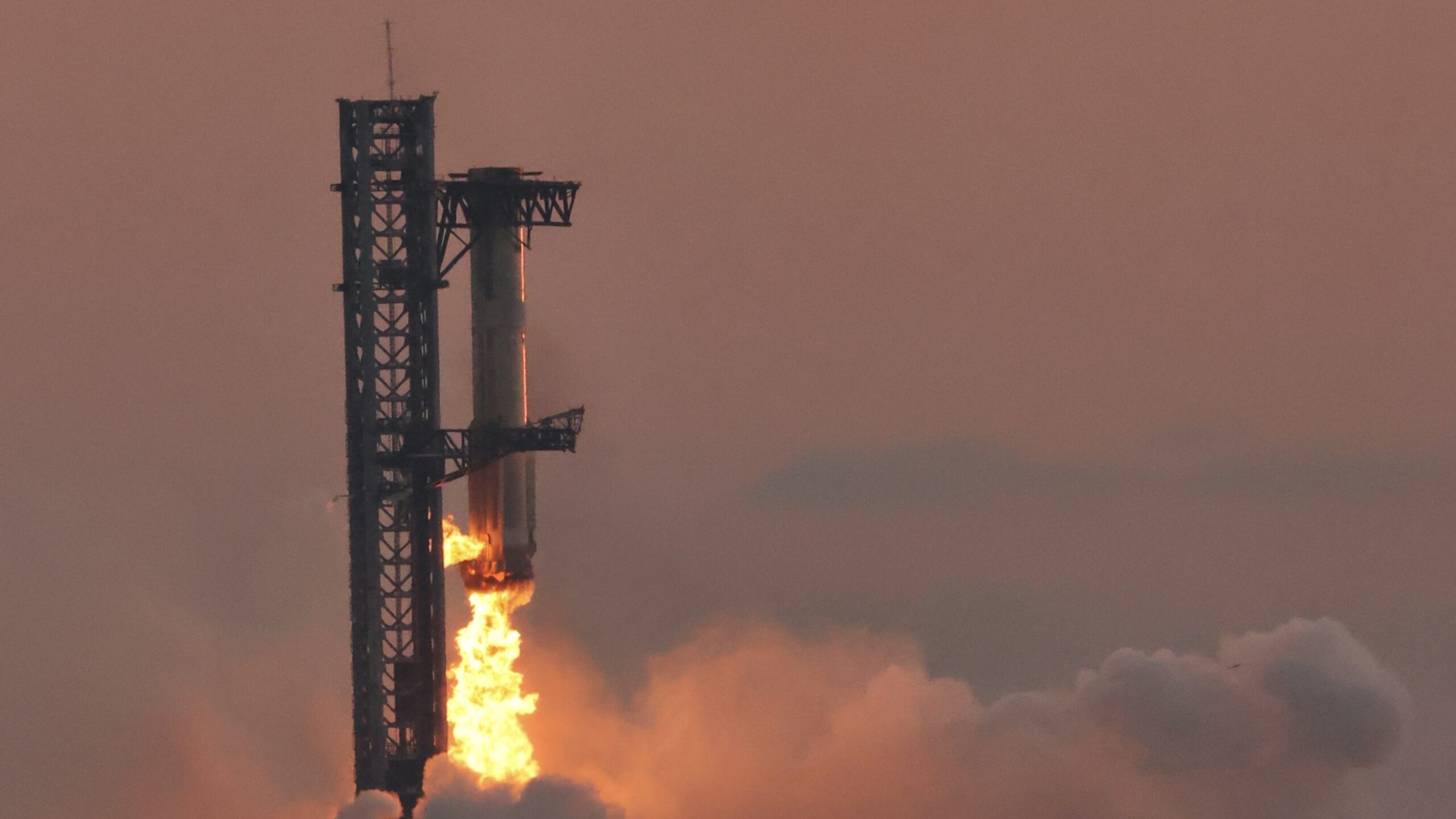
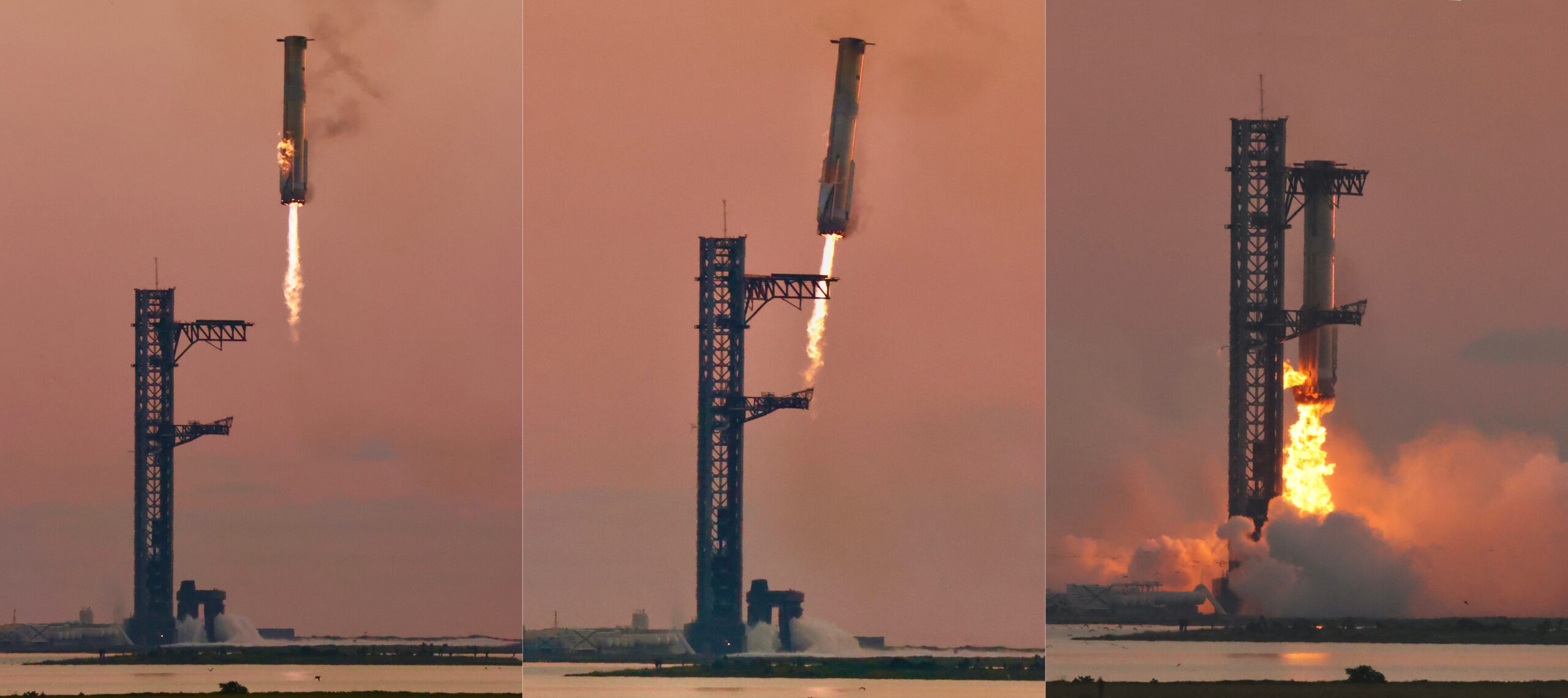
SpaceX’s name for the tower, on the Flight 5 page, is Mechazilla. The arms are the chopsticks. After the upper stage lights and separates, Super Heavy flips, burns back toward Starbase in Texas, and lights a landing burn so it is nearly hovering beside the tower. The arms close on it. The engines shut down. The booster is hanging on the tower, not standing on legs.
It is not a leap of faith at the last second. Flight 5’s own write-up says thousands of vehicle and pad criteria had to be met before the attempt. If they are not, the booster is supposed to give up and head for the water. That is what happened on Flight 6 (19 November 2024): automated health checks on the tower aborted the catch, and Super Heavy did a planned divert to a soft splashdown in the Gulf.
Why arms instead of legs? The heavy gear stays on the tower, which does not have to fly. The booster only has to present something the arms can grab. SpaceX has not published a kilogram figure for the landing legs this skips, so this piece does not invent one. What it has published, in the May 2026 Starship V3 update, is the hardware it is building the next catches around: three grid fins instead of four, each 50 percent larger, with a new catch point, rearranged so the same fins help lift the vehicle as well as catch it. On the tower, the chopsticks are shorter so they can track a returning vehicle faster, and the main actuators switch from hydraulic to electromechanical.
Falcon 9 does not do this. Legs and drone ships are the method that already works for the smaller booster. Chopsticks are the method SpaceX is betting on once the stage is big enough, and flies often enough, that a ship ride home is the slow part.
What’s real now
The catch is not a render. SpaceX’s flight pages call Flight 5 the first, Flight 7 the second, and Flight 8 the third. That is the whole success list as of 3 October 2026. Nothing in the Flight 9–14 write-ups is a tower catch. Those boosters were sent to planned splashdowns — including hard ones — while SpaceX tried other things (a reflown booster, a new landing-burn profile, then the V3 vehicle).
| Flight | Date | What SpaceX says the booster did |
|---|---|---|
| 5 | 13 Oct 2024 | Caught on the first attempt. Upper stage splashed down in the Indian Ocean. |
| 6 | 19 Nov 2024 | Catch aborted by tower health checks. Soft splashdown in the Gulf. |
| 7 | 16 Jan 2025 | Caught. SpaceX calls it the second. |
| 8 | 6 Mar 2025 | Caught. SpaceX calls it the third. The upper stage was lost on ascent. |
| 9 | 27 May 2025 | Not a catch. First reflight — the booster from Flight 7 — aimed at a splashdown zone, then broke up during the landing burn. |
| 10 | 26 Aug 2025 | Planned splashdown. Hovered, shut down, dropped into the water. |
| 11 | 13 Oct 2025 | Planned splashdown off Texas. Last flight SpaceX calls the first-generation Super Heavy. |
| 12 | 22 May 2026 | First V3 booster, from the second pad. Partial boostback, hard splashdown. Not a catch attempt. |
| 13 | 24 Jul 2026 | Boostback ended early. Hard splashdown in the Gulf. |
| 14 | 28 Sep 2026 | Splashdown in the Gulf. The boostback was deliberately run to burn leftover liquid oxygen and test the booster ahead of later return-to-launch-site flights. First Starship flight SpaceX calls orbital. |
Read the last rows carefully. Flights 12 through 14 are the new booster, the one with the new catch points, and SpaceX still did not try to catch them. Flight 14 says the splashdown profile was practice for return-to-launch-site missions later — not a missed catch. No Starship upper stage has been caught. Ships in this series either splashed down or were lost.
Numbers
- Tower catches SpaceX claims: 3 (Flights 5, 7, 8). Aborted catch attempts described by SpaceX: 1 (Flight 6).
- Catches since 6 March 2025: none, through Flight 14 on 28 September 2026.
- Upper stages caught: none.
- Falcon 9, for scale: SpaceX’s own vehicle counter, checked 3 October 2026, showed 690 launches, 643 landings, and 609 reflights. That is legs and drone ships, not chopsticks.
One calm limit on the count: it follows SpaceX’s flight pages, which use “first,” “second,” and “third” for the catches and describe splashdown zones after that. It is not a tally from livestream commentary.
What’s next
The V3 tower and booster changes are the catch system SpaceX has written down for the flights that still have to come back to the pad. They have not been demonstrated on a catch yet. The 15 September 2026 “Starship to Orbit” note still describes the end of a nominal mission as either an ocean splashdown or a return to the launch site for catch and reuse — for the ship as well as the booster. In March 2025, SpaceX also said it is building a launch-and-catch site at Kennedy Space Center’s Launch Complex 39A. That update does not show a catch in Florida, and this piece does not treat plans as landings.
Sources
- Starship’s fifth flight test (SpaceX) — first catch, 13 October 2024; “Mechazilla” and “chopstick arms.”
- Sixth flight test (SpaceX) — tower health checks aborted the catch.
- Seventh flight test (SpaceX) — second catch, 16 January 2025.
- Eighth flight test (SpaceX) — third catch, 6 March 2025.
- Ninth, tenth, eleventh, twelfth, thirteenth, and fourteenth flight tests (SpaceX) — booster outcomes through 28 September 2026.
- Introducing Starship V3 (SpaceX, 12 May 2026) — grid-fin catch points; shorter, electromechanical chopsticks.
- To the Moon and Beyond (SpaceX, 30 October 2025) — catch and reuse tied to launch cadence.
- Starship’s sonic boom (SpaceX, 29 July 2024) — return to the launch site as the reusability plan.
- Starship to Orbit (SpaceX, 15 September 2026) — ocean splashdown or return for catch and reuse.
- Future of Building Starship (SpaceX, 3 March 2025) — launch-and-catch site planned at Launch Complex 39A.
- Falcon 9 (SpaceX) — launch, landing, and reflight counter checked 3 October 2026.
Musk Industries is an independent archive — not affiliated with SpaceX, Tesla, Elon Musk, or related companies.