
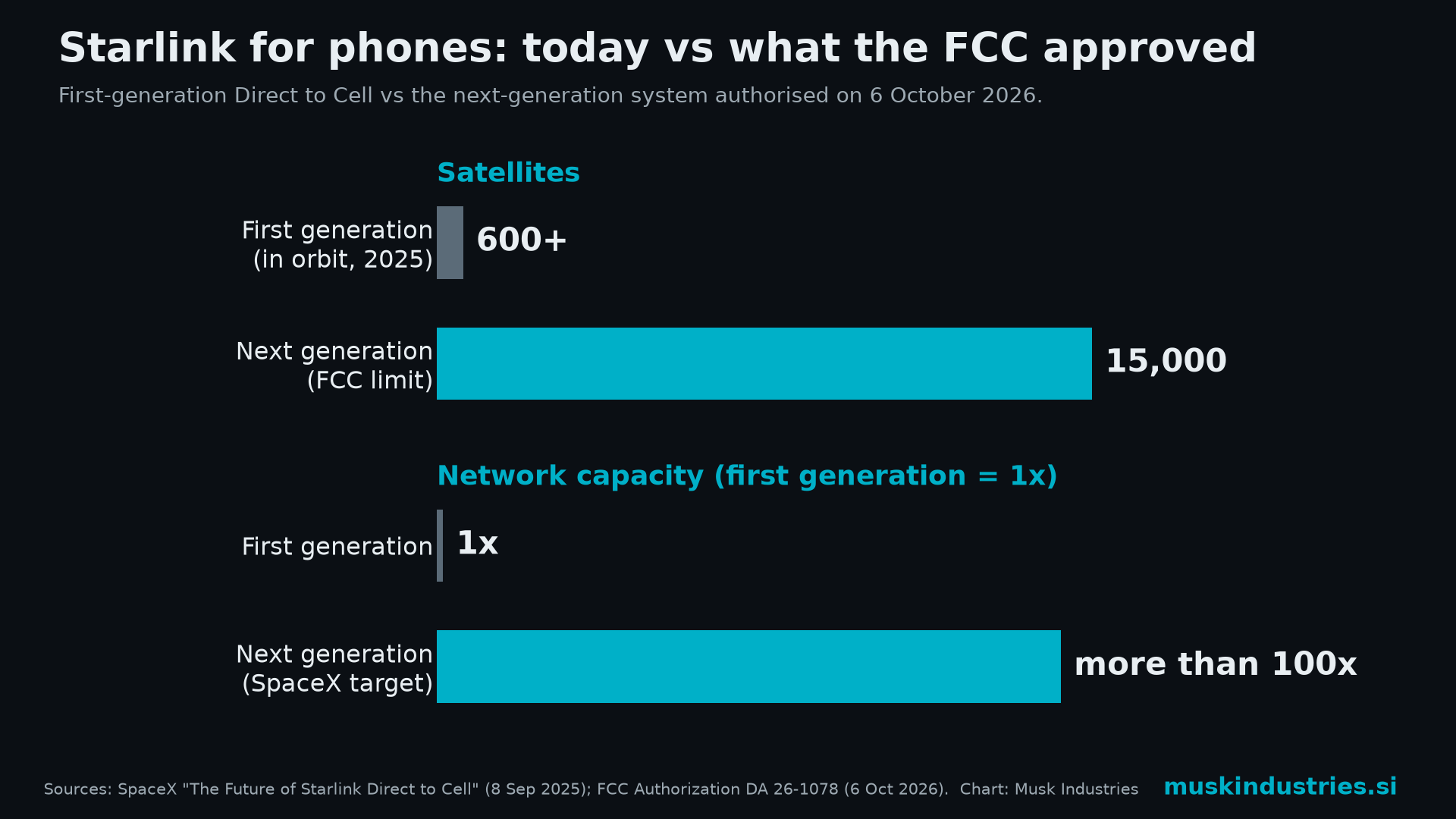
Short answer: Yes, and it already does. More than 600 Starlink satellites act as cell towers in space, letting ordinary LTE phones text and use some apps where there is no mobile signal, through carriers such as T-Mobile in the US and Optus and Telstra in Australia. On 6 October 2026 the US FCC approved SpaceX’s next step: up to 15,000 new satellites built for full mobile service, which SpaceX says will have more than 100 times the capacity of today’s network.
Why it matters
Mobile coverage stops where the towers stop. When SpaceX began this service in January 2024, more than 20% of US land area and 90% of the Earth had no ground-based mobile signal. That is where hikers get lost, farmers lose contact and crashes on remote roads go unreported. After hurricanes, floods and wildfires in the US, SpaceX says more than 1.5 million people used its satellite-to-phone service while the ground networks were down. Turning that from emergency texting into normal calls and data would make “no signal” a much rarer thing.
How it works
Your phone already knows how to talk to a cell tower. Starlink’s trick is to put the tower in orbit. Each Direct to Cell satellite carries the same kind of radio equipment a mobile tower uses, plus a large phased-array antenna that can pick out a phone’s weak signal from hundreds of kilometres up. To your phone, the satellite looks like a roaming partner, so there is no new handset, app or software. You just need a clear view of the sky.
The satellites fly low, about 360 km up for the first generation, because a phone’s tiny antenna needs every bit of help it can get. They pass the traffic to the rest of the Starlink network over laser links between satellites, so a message can reach the internet from almost anywhere.
The next generation is a bigger version of the same idea. SpaceX says custom chips and antennas with thousands of separate beams will give each satellite about 20 times the throughput of a first-generation one, and the system as a whole more than 100 times the capacity. The goal is 5G-style service that feels “comparable to current terrestrial LTE” in most places.
What’s real now
- It works on normal phones: days after the first Direct to Cell launches in January 2024, SpaceX was texting from unmodified phones; it showed video calls that spring.
- The first network is complete: by September 2025 SpaceX had more than 600 Direct to Cell satellites in orbit, running across five continents, and said it was connecting more than six million users.
- More than texting: customers can use apps such as X, WhatsApp, Google Maps and AccuWeather over the satellites, though speeds are still modest (about 4 Mbit/s today, according to Light Reading).
- Carrier partners: T-Mobile (US), Optus and Telstra (Australia), Rogers (Canada), One New Zealand, KDDI (Japan), Salt (Switzerland), Entel (Chile and Peru), Kyivstar (Ukraine) and, since 7 October 2026, Banglalink (Bangladesh), where customers can message over apps and share location in dead zones.
- The new licence: the FCC’s 6 October order lets SpaceX launch up to 15,000 satellites in nine shells between 326 and 335 km. It covers mobile service inside the US and direct-to-cell service abroad, using spectrum SpaceX is buying from EchoStar, and lets SpaceX offer some services without leasing airwaves from a mobile carrier. Some spectrum requests were deferred.
- Its own ground-tower airwaves too: on 8 October 2026 (US time) SpaceX announced a deal to buy a nationwide 800 MHz low-band licence portfolio from Grain Management (up to 14 MHz of paired spectrum), which it says will let Starlink Mobile become a major US mobile carrier. SpaceX says the low band gets signal through walls into buildings and that most existing phones already support it. The spectrum is meant for ground towers rather than satellites, no price was disclosed, and the deal still needs FCC approval.
| First generation (today) | Next generation (approved 6 Oct 2026) | |
|---|---|---|
| Satellites | 600+ (Sept 2025) | Up to 15,000 |
| Altitude | About 360 km | 326 to 335 km |
| What it does | Texts, some apps, emergency alerts | Calls, data and video, 5G-style |
| Capacity | 1x | More than 100x (SpaceX target) |
| Airwaves | Leased from carriers like T-Mobile | Own spectrum from EchoStar, plus carrier spectrum |
How it compares
SpaceX is not the only company putting phone service in orbit. AST SpaceMobile is building very large satellites designed to work with existing phones, with AT&T and Verizon as partners. Apple’s iPhone emergency texting runs on Globalstar’s satellites. Last week AT&T, T-Mobile and Verizon launched a joint venture to pool spectrum for satellite service (Light Reading). SpaceX’s edge is scale: it already has hundreds of these satellites working and its own rockets to launch thousands more. The others are betting on bigger satellites, existing carrier relationships or both.
What’s next
- 2027: SpaceX President Gwynne Shotwell has said second-generation Starlink Mobile satellites start flying next year, with service by the end of 2027 (Via Satellite). Japan’s KDDI is aiming for the same date.
- Starship: the bigger satellites need Starship, which reached orbit for the first time on 28 September. Flight 15 is pencilled in for no earlier than 19 October.
- On or about 30 November 2027: SpaceX’s full use of the EchoStar spectrum depends on the last step of that deal closing, expected around this date, though it can launch and test before then.
- 7 October 2032: half of the 15,000 satellites must be up and working.
- 7 October 2035: the full constellation must be in place.
We will update this page in place as the new satellites launch.
Sources
- FCC Authorization and Order DA 26-1078: SpaceX NGSO MSS System (FCC, 6 October 2026) — 15,000 satellites, nine shells at 326–335 km, scope of service, carrier-lease waiver, deferred bands, 2032 and 2035 deadlines.
- FCC Memorandum Opinion and Order DA 26-471: SpaceX–EchoStar spectrum (FCC, 12 May 2026) — spectrum assignment and expected final closing on or about 30 November 2027.
- SpaceX on X: agreement to acquire a nationwide low-band spectrum portfolio for Starlink Mobile (8 October 2026) — see also SpaceX update; carrier ambition, building penetration, existing-phone support.
- Teslarati: SpaceX takes aim at Verizon, AT&T and T-Mobile (9 October 2026) — secondary; Grain Management statement (800 MHz, up to 14 MHz paired), no price, FCC approval needed.
- Starlink on X: Starlink Mobile now available in Bangladesh with Banglalink (7 October 2026) — Banglalink added as a carrier partner; app messaging and location sharing in cellular dead zones.
- The Future of Starlink Direct to Cell (SpaceX, 8 September 2025) — first-generation facts (600+ satellites, 360 km, six million users, partners, emergency use) and next-generation targets (about 20x per satellite, more than 100x system capacity).
- Starlink Direct to Cell (Starlink) — product page.
- Via Satellite: FCC grants SpaceX approval for 15,000 direct-to-device satellites (7 October 2026) — secondary; Shotwell on 2027 timing and “100 times better”.
- Light Reading: FCC OKs SpaceX to deploy 15K D2D satellites (7 October 2026) — secondary; current speed figure, carrier joint venture, other D2D players.
- TechSpot: FCC approves 15,000 Starlink Mobile satellites (7 October 2026) — secondary; KDDI end-2027 target.
Top image: a Falcon 9 rocket launches a batch of Starlink satellites from Vandenberg Space Force Base, California, in April 2026 (illustrative; not a Direct to Cell-specific launch). Photo: U.S. Space Force / 2nd Lt. Andrew Taller via Wikimedia Commons, public domain, cropped to 16:9.
Musk Industries is an independent explainer. Not affiliated with Elon Musk, Tesla, or SpaceX.