
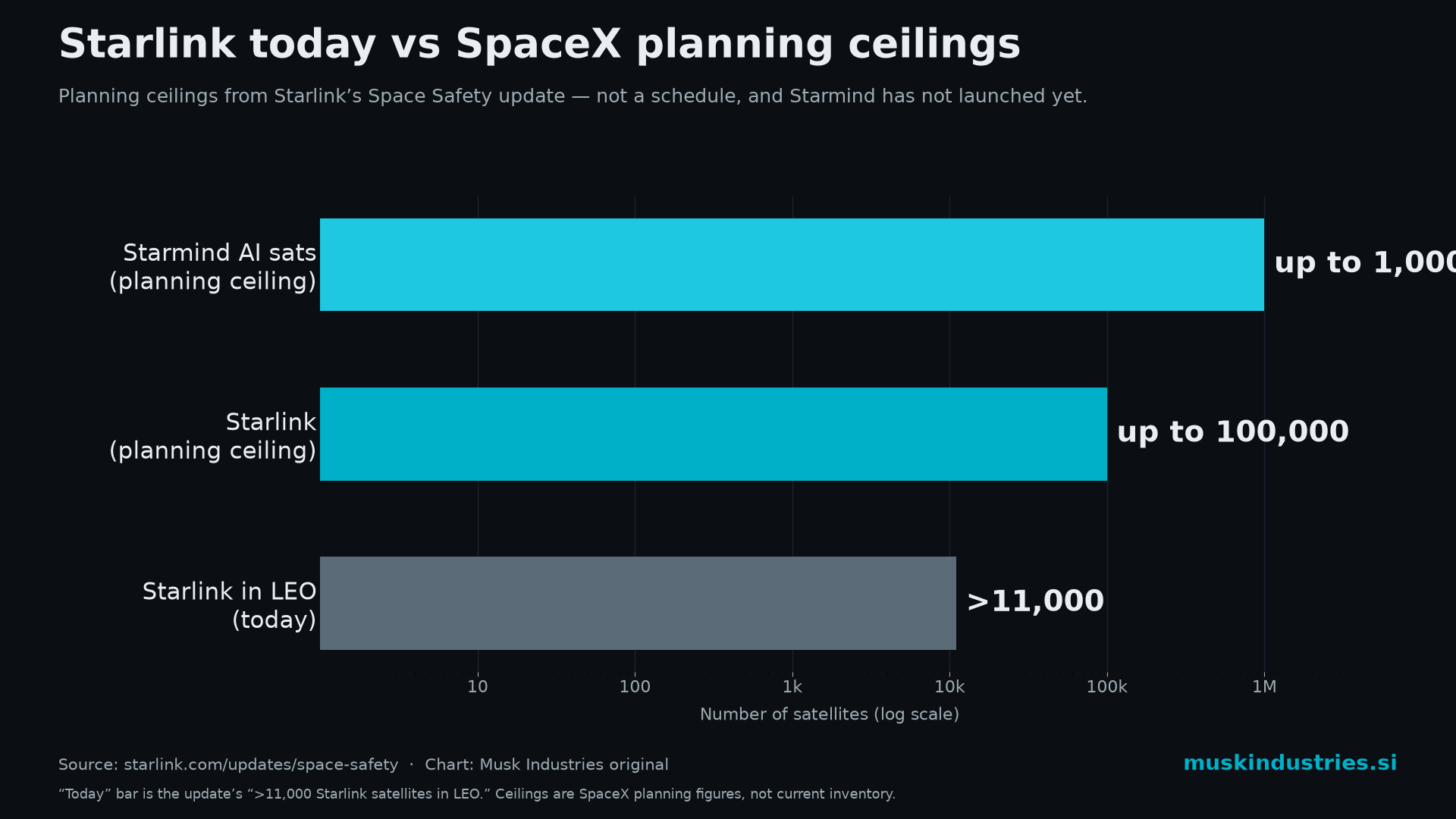
Short answer: Starmind is SpaceX’s planned constellation of AI computers in orbit — satellites that run compute in space and send results back through Starlink. SpaceX says it will start launching next year and plans to scale to as many as 1 million satellites, alongside growing Starlink to as many as 100,000. The company argues that only works if every operator shares orbit and maneuver data; Starlink already publishes hourly ephemeris and offers free conjunction screening through Space-Safety.com and its onboard Stargaze sensor network.
Why it matters
Starlink already runs more than 11,000 satellites in low-Earth orbit. SpaceX’s Space Safety update ties a much larger future — up to 100,000 Starlink broadband satellites plus up to 1 million Starmind AI satellites — to one condition: operators have to share where their satellites are and when they plan to move. Without that data, collision screening relies on third-party radar and optical tracks that go stale the moment someone burns without warning.
Starmind is the other half of that bet. SpaceX wants to take the kind of terrestrial compute it is building at Colossus 1 and 2 in Memphis, Tennessee, and Southaven, Mississippi, and put it in sun-synchronous orbit, where solar power is continuous and cooling overhead drops by an order of magnitude compared with ground data centres. Results come home over Starlink’s laser mesh. That only scales if the sky stays orderly.
How it works
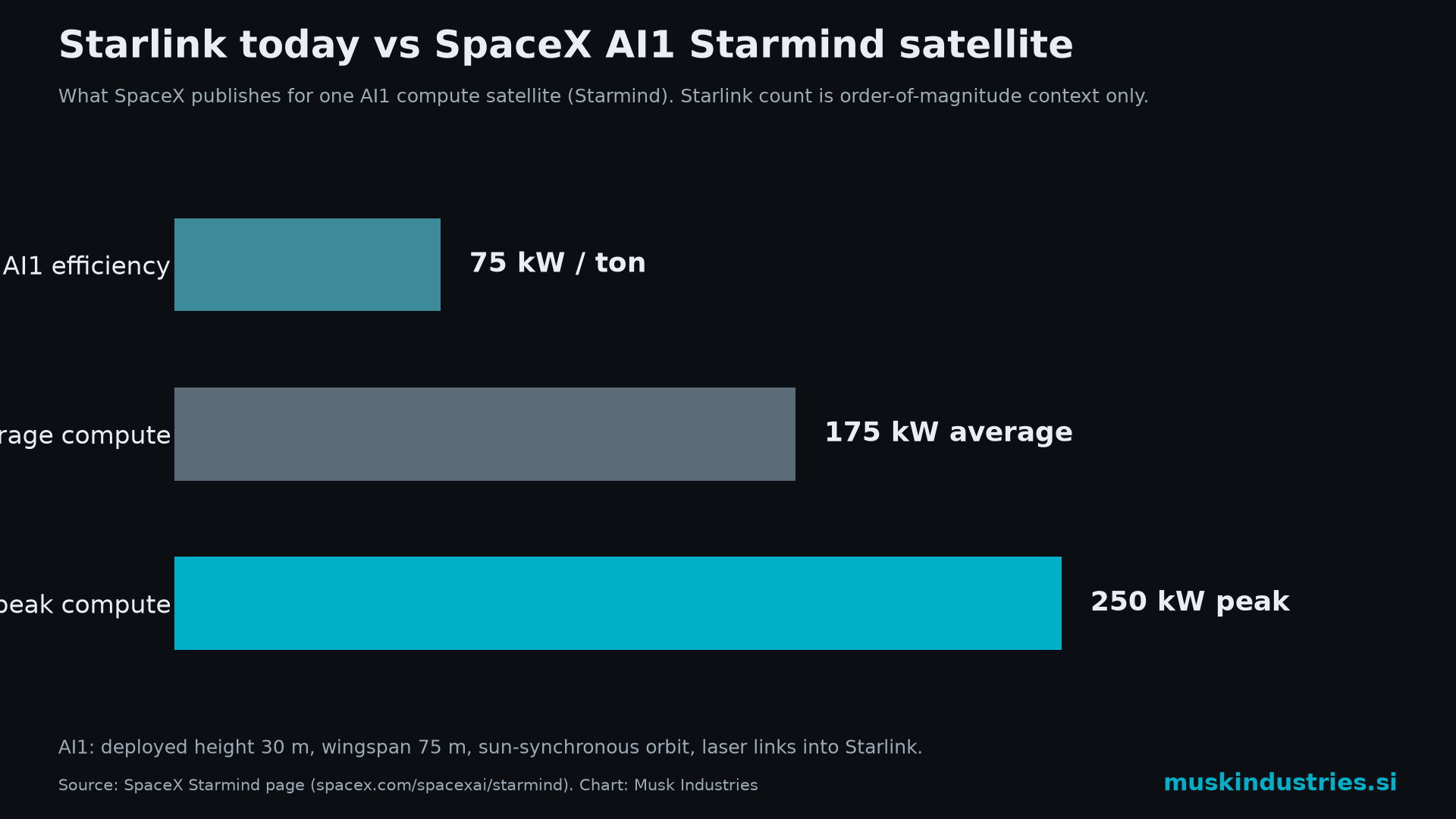
Starmind AI1 is the satellite SpaceX describes on its Starmind page: a vehicle with localized AI compute that beams results back through Starlink. Published specs put deployed height at 30 m (98 ft), wingspan at 75 m (246 ft), compute at up to 250 kW peak / 175 kW average, and efficiency at 75 kW per ton. The architecture is chip-vendor agnostic and modular. Cooling radiates into vacuum; laser links connect satellites and carry results to Earth.
The safety stack is what SpaceX says makes a denser LEO workable:
- Hourly ephemeris: after launch, trajectories go public within 2–3 hours from rocket telemetry and onboard GNSS; then every Starlink’s ephemeris is updated hourly for life. A public mirror lives at api.starlink.com/public-files/ephemerides.
- Space-Safety.com: a free platform where operators upload trajectories, download others’, and get Conjunction Data Messages (CDMs) within about a minute, screened against each other and the Stargaze catalog.
- Stargaze: more than 31,000 star trackers on the Starlink fleet take opportunistic optical observations of nearby objects, downlink them in seconds over the laser mesh, and push updated trajectories for CDMs about 60 seconds after submission — hours of traditional SSA compressed into minutes.
SpaceX says those practices line up with the 2026 AIAA Orbital Safety Best Practices, developed with AIAA, Amazon Leo, Eutelsat, Iridium and SpaceX.
What’s real now
- Starlink fleet: more than 11,000 satellites in LEO; the first 26 Starlink V3 satellites flew at the end of September 2026.
- Platforms live: Space-Safety.com is open for free ephemeris sharing and screening; public ephemeris files are mirrored online.
- Stargaze in use: SpaceX cites two close-approach cases. On 1 October 2025, STARLINK-32710 saw a predicted miss shrink from about 9 km to 57 m after another satellite maneuvered; a Stargaze update in under an hour and an avoidance burn restored roughly a 1 km miss. In August 2026, STARLINK-2140 got CDMs with only 30 minutes of lead — too late for a burn — ducked to a knife-edge profile, and passed within 134 m.
- The data gap: in 2026 Starlink saw conjunctions with about 650 unique maneuvering third-party satellites, and only about half shared ephemeris. Over six months it logged roughly 164,000 conjunctions whose closest approach fell within four hours after an unannounced maneuver. Constellation shells can be about 50× denser than nearby altitudes; SpaceX gives an example daily collision probability of about 5×10⁻⁵ for a 1 m object with degraded predictions overlapping those shells.
- Gigasat planned, not shipping: SpaceX is building a Gigasat Factory in Bastrop to manufacture AI satellites at scale, with thousands starting as soon as late 2027. Mass to orbit depends on Starship; chips are tied to Terafab. Related reading: Starlink Direct to Cell and Google’s Project Suncatcher.
Numbers
| Item | Figure | Status |
|---|---|---|
| Starlink in LEO | >11,000 | Operating |
| First Starlink V3 | 26 sats, end of Sep 2026 | Deployed |
| Starlink planning ceiling | up to 100,000 | Plan |
| Starmind planning ceiling | up to 1,000,000 | Plan — launches next year |
| AI1 height / wingspan | 30 m / 75 m | Published design |
| AI1 compute | up to 250 kW peak / 175 kW avg; 75 kW/ton | Published design |
| Stargaze star trackers | >31,000 on Starlink fleet | Operating |
| CDM turnaround after upload | ~60 seconds (Space-Safety.com) | Operating |
| 2026 third-party conj. sats | ~650 unique; ~half sharing ephemeris | Reported |
| Unannounced-maneuver conj. (6 mo) | ~164,000 with TCA within 4 hours | Reported |
| Gigasat Factory (Bastrop) | thousands of AI sats | Planned from late 2027 |
What’s next
- Starmind deployments: SpaceX says it will begin launching the AI constellation next year and scale toward the million-satellite planning ceiling.
- Gigasat production: Bastrop is meant to enable thousands of AI satellites starting as soon as late 2027.
- Safety bar: SpaceX is asking every LEO operator to publish GNSS ephemeris (including planned burns and post-burn updates), upload to a coordination platform, and avoid inserting straight into dense shells.
We will update this page in place as Starmind launches and as the Space Safety figures change.
Sources
- Space Safety: The Need for Improved Data Sharing Between Operators in Low-Earth Orbit (Starlink / SpaceX) — >11,000 Starlink; first 26 V3; up to 100,000 Starlink + up to 1 million Starmind; Starmind next year; ephemeris timing; Space-Safety.com; Stargaze >31,000 trackers; 650 / half-sharing; ~164,000 unannounced-maneuver conjunctions; density and Pc example; STARLINK-32710 and STARLINK-2140 cases; Colossus 1 & 2; AIAA 2026 practices.
- Starmind (SpaceX) — AI1 height, wingspan, compute, efficiency; SSO / cooling / modular / laser links; Gigasat Factory, late 2027; Starship and Terafab as limiting factors.
- Space-Safety.com (Starlink) — free ephemeris sharing and conjunction screening platform.
- Starlink public ephemerides README — public mirror of ephemeris files uploaded to space-track.org.
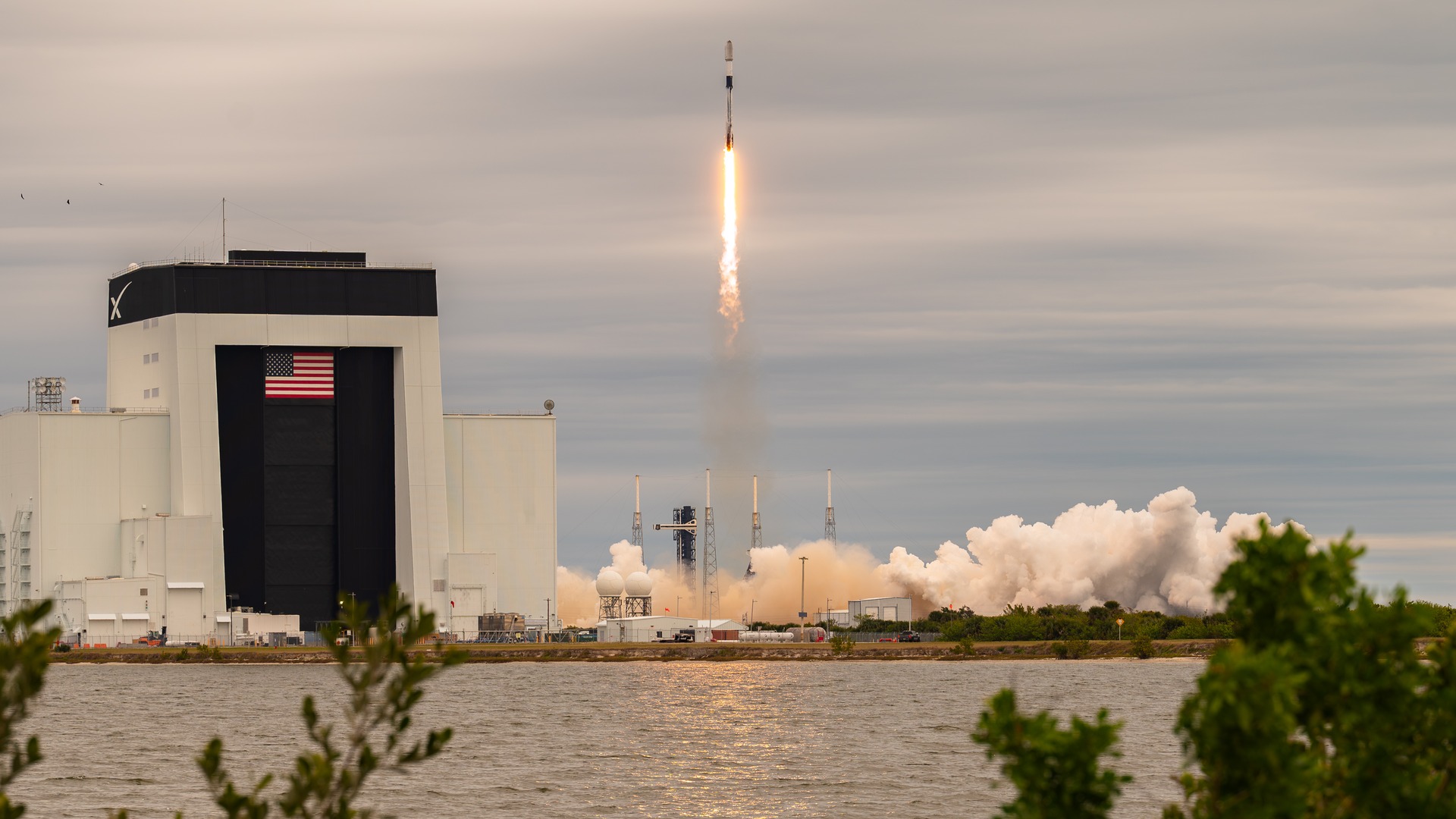
Top image: U.S. Space Force / DeAnna Murano, Starlink 12-4 launch from CCSFS, public domain via Wikimedia Commons; cropped to 16:9. Illustrative of Starlink launch operations, not a Starmind satellite.
Musk Industries is an independent archive — not affiliated with SpaceX, Tesla, Elon Musk, or related companies.