
Short answer: Yes, the ship half now works. On Flight 15, which lifted off on 13 November 2026 (US time), Starship went to orbit, released 26 Starlink V3 satellites, and about 22.5 hours after liftoff came back to Starbase, where the launch tower caught it. It was the first time a Starship upper stage has been caught. The Super Heavy booster was not caught this time: its boostback burn ended early, so it diverted to a planned landing burn over the Gulf. SpaceX has caught three earlier boosters.
Why it matters
SpaceX says recovering an entire orbital launch system has never been done. It calls this the “Holy Grail of rocketry”, because a rocket that comes back in one piece can fly again quickly, more like an airliner than a firework.
That is what Starship needs for its bigger jobs: carrying far more Starlink satellites per launch, refuelling in orbit, and landing cargo and crews on the Moon for NASA’s Artemis program. Catching the booster is already proven. Catching the ship, after it has been to orbit and back through the heat of reentry, is the new part.
How it works
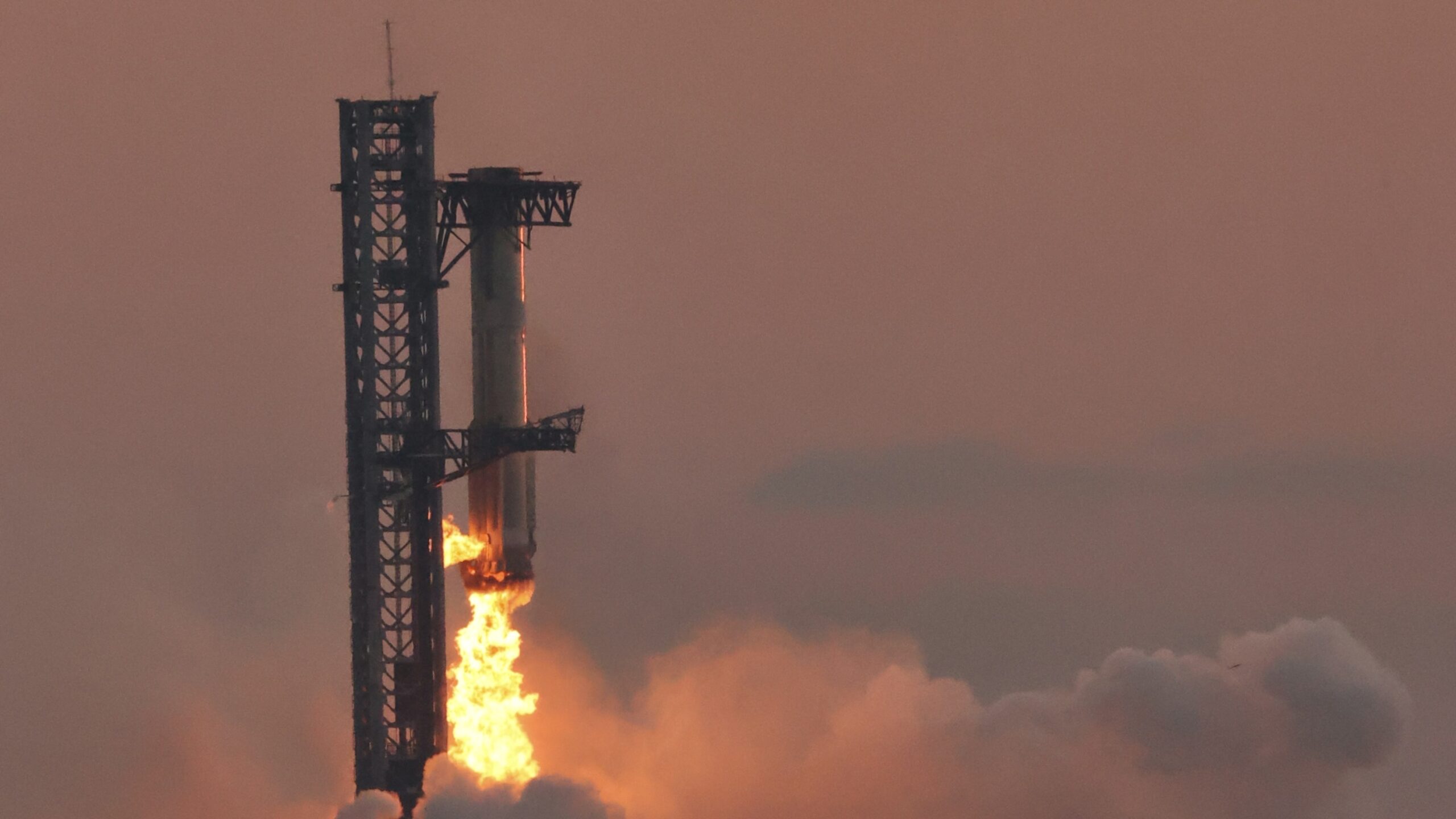
The booster comes home in minutes. About two and a half minutes after liftoff, the ship lights its engines and separates (hot staging). Super Heavy flips, burns back toward Starbase in Texas and, about six and a half minutes into the flight, slows to a near hover so the tower’s arms (the “chopsticks”) can close on it. This is the first catch attempt for the new V3 booster. How the chopsticks work.
The ship goes to orbit and does a day’s work. Starship first coasts on a “passively safe” path that would splash down in the Indian Ocean if anything looked wrong. If controllers give a go, one Raptor engine pushes it into orbit about 275 km up. It then releases 26 Starlink V3 satellites over roughly 40 minutes. Three of them carry cameras to photograph Starship’s heatshield, one of the data sources SpaceX uses to decide whether the ship is fit to come home.
Then it waits for Starbase to come around. The ship coasts for about 21 more hours, around 14 orbits, until its path lines up with Texas. Controllers keep checking engines, power, communications, flight computers, tanks and steering the whole time, with pre-cleared splashdown spots near Hawaii and off Chile if they want to end early.
The catch. If every condition is met, a single Raptor fires to bring Starship down. It reenters over the Pacific, uses its four flaps to steer a path over sparsely populated parts of northern Mexico and southern Texas, and swings in from the Gulf toward the tower. Just before the tower it falls belly first, lights three engines to flip upright, drops to two and then one as it nears a hover, and the arms close on two catch fittings just below its forward flaps. Locals in Cameron County may hear sonic booms. If anything is off late in reentry, it can divert into the Gulf instead.
What happened on Flight 15
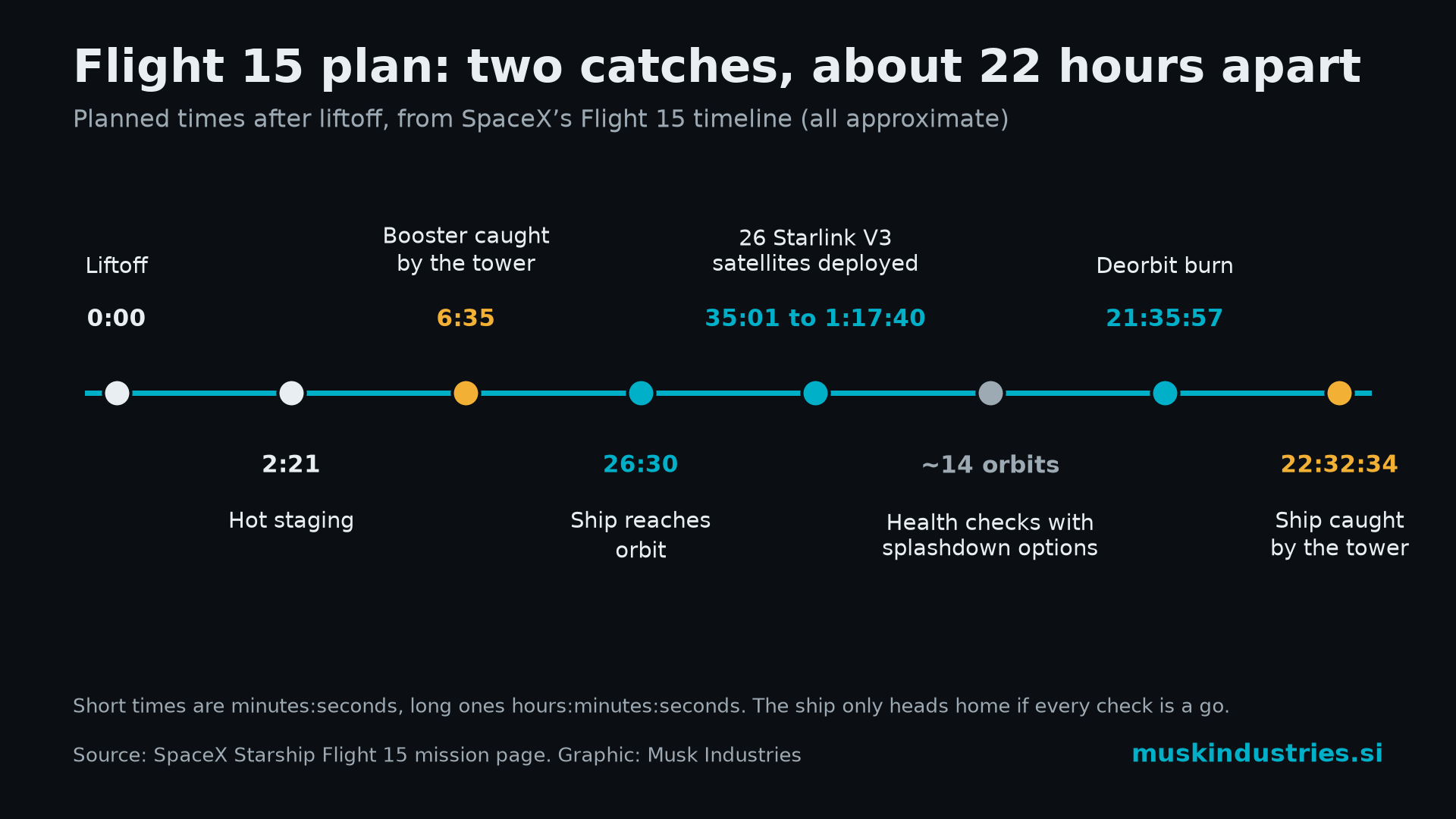
The ship flew the plan below almost exactly, and the catch worked. More on why that matters: Why is catching Starship such a big deal?.
What’s real now
- Booster catches: three first-generation Super Heavy boosters have been caught by the tower, and two of them have flown again, according to SpaceX.
- Orbit: Flight 14 on 28 September 2026 was the first Starship to reach orbit and leave satellites up there. What Flight 14 actually did.
- Reentry: earlier ships splashed down on target in the ocean, including on purpose with heatshield tiles removed and with harder maneuvers than a normal return, to prove the ship survives with margin.
- Ship caught: on 14 November 2026 (US time) the tower caught Starship after its flight to orbit, the first upper stage ever caught. Elon Musk wrote on X that the heatshield and engines look great and the ship could probably fly again after a few weeks of refurbishment.
- Booster not caught this time: Super Heavy’s boostback burn ended early on low fuel, so its computers aborted the catch and sent it to a planned landing burn over the Gulf. SpaceX says the root cause is under investigation.
- Satellites: all 26 Starlink V3 satellites were released and SpaceX made contact with every one.
The numbers
| Flight 15 plan | Figure |
|---|---|
| Booster catch | about 6 min 35 s after liftoff |
| Orbit altitude | about 275 km |
| Payload | 26 Starlink V3 satellites, about 1 Tbps of capacity each |
| Capacity added | about the same as 10 Falcon 9 launches of Starlink V2 Mini satellites |
| Time in orbit | about 14 orbits |
| Ship catch | about 22 h 32 min after liftoff |
These were SpaceX’s planned timings. On the day, the ship was caught about 22.5 hours after liftoff; the booster did not attempt its catch.
What’s next
- Booster fix: SpaceX is investigating why the boostback burn ended early.
- Reflying a caught ship: Musk says Ship 42 could probably be reflown after a few weeks of refurbishment, though many small fixes are still needed before airline-style reuse.
- After that: in-space refuelling between two Starships, the step NASA’s Moon landing plan depends on.
- Promises vs delivery: we track the big Starship timelines on the Musk Timeline Tracker.
We will update this page in place as caught ships and boosters fly again.
Sources
- Elon Musk on X, 15 November 2026 (UTC): heatshield and engines look great, Ship 42 reflight after a few weeks of refurbishment. Primary.
- Starship Flight 15 (SpaceX): date, window, objectives, 275 km orbit, 14 orbits, 26 Starlink V3 satellites and capacity, heatshield cameras, booster catch history, full timeline. Primary.
- Returning Starship to the Launch Site (SpaceX update, 7 November 2026): safety checks, splashdown options, reentry path, catch sequence, sonic booms, “Holy Grail of rocketry”. Primary.
- SpaceX on X, 7 November 2026: “Starship is preparing for catch”. Primary.
Top image and timeline: Musk Industries originals from SpaceX’s published plan. Booster photo: Steve Jurvetson / Wikimedia Commons, CC BY 2.0.
Musk Industries is an independent archive, not affiliated with Tesla, SpaceX, Elon Musk or related companies.