
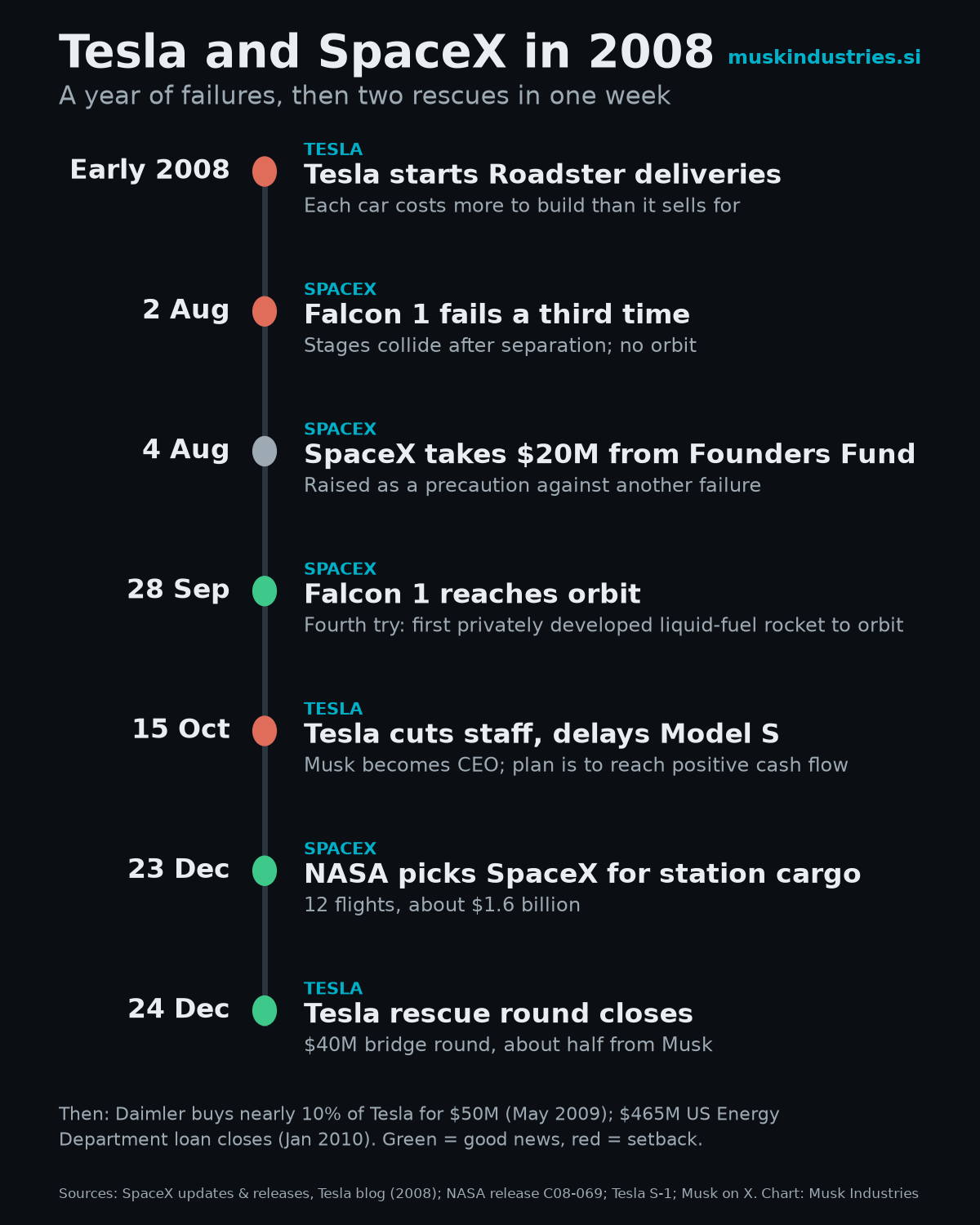
Short answer: Very close, and both pulled through. By August 2008 SpaceX’s Falcon 1 rocket had failed to reach orbit three times, and by December Tesla was close to missing payroll. Then the fourth Falcon 1 reached orbit on 28 September 2008, NASA picked SpaceX for a $1.6 billion space station cargo contract on 23 December, and Tesla’s rescue round closed on Christmas Eve, in the “last hour of last day possible” in Musk’s words, with Musk putting in about half of the $40 million.
Why it matters
SpaceX and Tesla now make up almost all of Musk’s on-paper fortune (see Is Elon Musk really that rich?). In 2008 both were small companies in the middle of a financial crisis, Tesla was losing money, and, as Musk later put it, both “narrowly escaped bankruptcy”. How they got through explains a lot: why NASA’s bet on commercial rockets mattered, why Tesla started with an expensive sports car, and why Musk’s money is still tied up in the two companies rather than sitting in a bank.
What happened
Musk funded the early years himself. In his own words on X, he got rich from Zip2 and PayPal and “put 100% of that into SpaceX, Tesla & SolarCity”. At Tesla, he says he “personally provided almost all Tesla funding, based on my proceeds from PayPal, from Series A in 2004 until Series C in 2007”. He was Tesla’s chairman before becoming CEO in October 2008.
Three launches, three failures. Falcon 1’s first flight, on 24 March 2006, ended when a fuel leak started a fire around the main engine, which shut down 29 seconds after liftoff. The second, on 21 March 2007, reached space (289 km) but its second stage shut down early, at 5.1 km/s against the 7.5 km/s needed for orbit. On the third, on 2 August 2008 (US time), the first stage worked perfectly, but leftover engine thrust pushed it into the second stage after separation. That day Musk told staff SpaceX had “recently accepted a significant investment” as a precaution against another failure. Founders Fund’s $20 million was announced two days later.
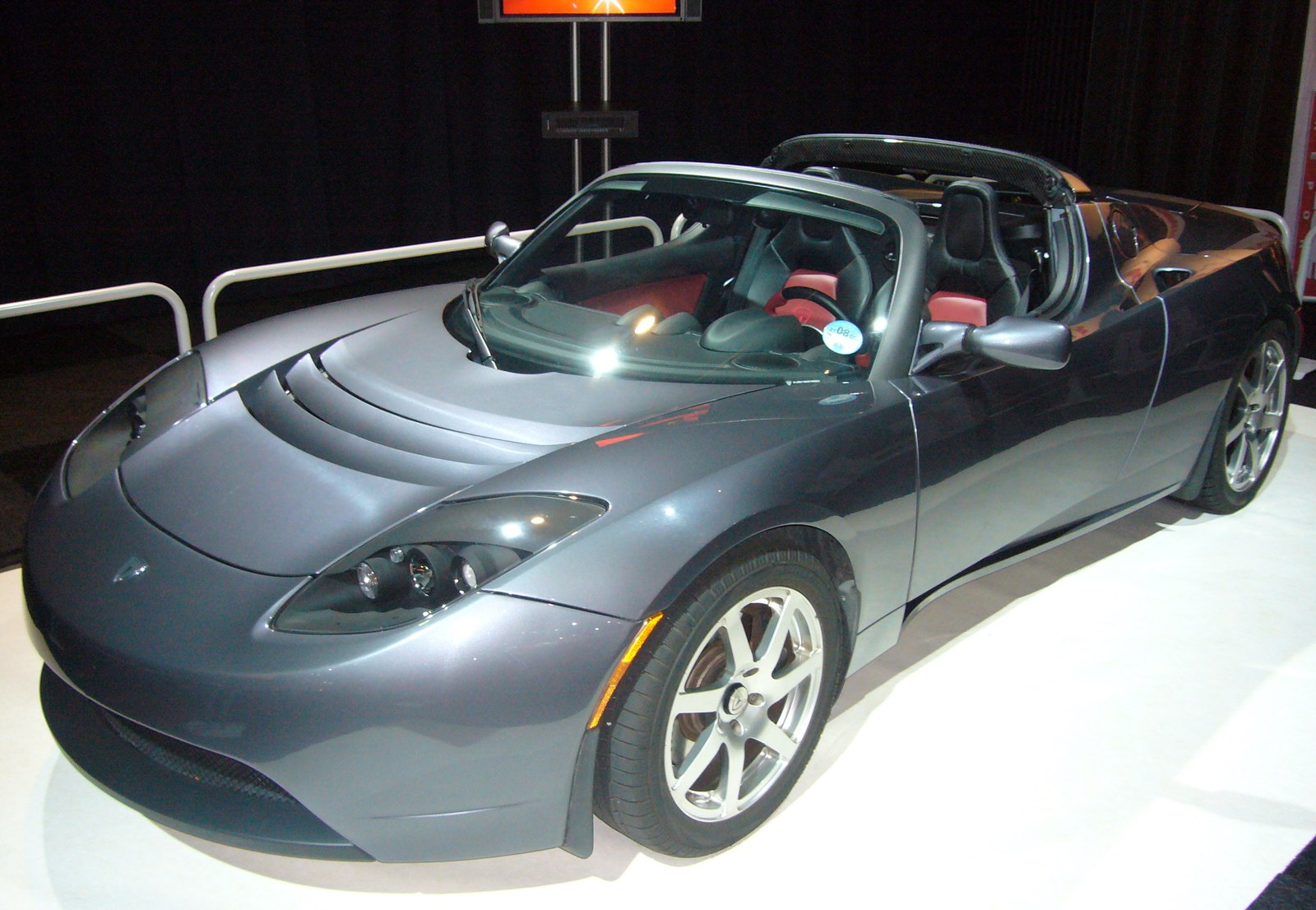
Tesla’s first car lost money. Tesla began delivering the Roadster in early 2008. Its own later filing says each car cost more to make than it sold for, and the company lost $82.8 million that year. On 15 October 2008 Musk wrote on Tesla’s blog that he was taking over as CEO, cutting headcount, closing the office near Detroit and delaying the Model S “roughly six months to mid-2011”, with a goal of being cash-flow positive within six to nine months.
The fourth launch worked. On 28 September 2008 Falcon 1 reached orbit with a 165 kg dummy payload. SpaceX called it the first privately developed liquid-fuel rocket to orbit Earth. Musk’s post-launch note: “middle of the bullseye”.
Last money in. “In late 2008, I gave Tesla the last money I had. It was that or the company would have died,” Musk wrote on X in 2023. “I gave my last money thinking Tesla would probably still die, not thinking that it would be lucrative.”
Christmas week. On 23 December NASA ordered 12 cargo flights to the International Space Station from SpaceX, worth about $1.6 billion. The next evening Tesla’s funding closed. “Tesla financing round closed at 6pm Dec 24th 2008 – last hour of last day possible or payroll would’ve bounced 2 days later,” Musk wrote in 2021. Tesla’s 2010 IPO filing shows the round: $40 million of secured convertible notes issued from December 2008 to March 2009, of which Musk’s trust put in $20.4 million.
What’s real now
- Both survived, and outside investors followed. In May 2009 Daimler bought nearly 10% of Tesla for $50 million (19.9 million shares at $2.51). A further $82 million round followed in August 2009.
- Tesla’s US Energy Department loan of up to $465 million closed on 20 January 2010, for the Model S factory and its powertrain plant.
- The Roadster turned a corner. Tesla says its car sales first covered their costs in the nine months to September 2009.
- SpaceX’s NASA contract was for cargo runs on its then-unflown Falcon 9 rocket and Dragon capsule. Today’s rockets are a long way from Falcon 1: see Did SpaceX’s Starship reach orbit? and Why does SpaceX catch boosters with chopsticks?
Numbers
| Date | What happened | Number |
|---|---|---|
| 24 Mar 2006 | Falcon 1 flight 1 fails | Engine shut down 29 seconds after liftoff |
| 21 Mar 2007 | Falcon 1 flight 2 reaches space, not orbit | 5.1 of 7.5 km/s needed |
| 2 Aug 2008 | Falcon 1 flight 3 fails at stage separation | Peaked at 217 km |
| 4 Aug 2008 | Founders Fund invests in SpaceX | $20 million |
| 28 Sep 2008 | Falcon 1 flight 4 reaches orbit | 165 kg dummy payload |
| 2008 (full year) | Tesla net loss | $82.8 million |
| 23 Dec 2008 | NASA cargo contract for SpaceX | 12 flights, ~$1.6 billion |
| Dec 2008–Mar 2009 | Tesla bridge round | $40 million; $20.4 million from Musk’s trust |
| May 2009 | Daimler stake in Tesla | ~10% for $50 million |
| 20 Jan 2010 | Energy Department loan closes | Up to $465 million |
Method note: dollar figures are as reported at the time, not adjusted for inflation. Quotes from Musk are his own later posts on X.
Sources
- SpaceX updates page, archived October 2008: Falcon 1 flight 3 summary (217 km, stage collision), Musk’s 2 August 2008 note to employees, flight 4 launch update (28 September, 23:15 UTC).
- SpaceX: Falcon 1 Flight 4 summary (archived) and SpaceX release via SpaceNews (29 September 2008): orbit, 165 kg payload, first privately developed liquid-fuel rocket to orbit.
- SpaceX: Founders Fund investment (4 August 2008, archived): $20 million.
- SpaceX statement by Elon Musk, reprinted by Spaceflight Now (28 March 2007): flight 2 altitude and velocity.
- SpaceX updates page, archived April 2006: Falcon 1 flight 1 (24 March 2006), fuel-leak fire, engine shutdown at T+29 seconds.
- NASA contract release C08-069 (23 December 2008, archived) and SpaceX release (23 December 2008, archived): 12 flights, ~$1.6 billion.
- Tesla Motors Form S-1 (SEC, 29 January 2010): 2008 net loss, Roadster costs, December 2008 bridge notes and Musk trust amount, Series E (Daimler/Blackstar) and Series F, DOE loan closing.
- Tesla and Daimler joint release: Daimler acquires stake in Tesla (19 May 2009, Tesla IR, archived): nearly 10% stake.
- Elon Musk on X (21 June 2021): Christmas Eve 2008 closing, payroll.
- Elon Musk on X (24 February 2023): funded almost all of Tesla from Series A (2004) to Series C (2007); gave Tesla his last money in late 2008.
- Elon Musk on X (25 May 2013): put 100% of his Zip2 and PayPal money into SpaceX, Tesla and SolarCity.
- Elon Musk on X (30 March 2022): both companies “narrowly escaped bankruptcy in 2008”.
- Tesla blog: “Extraordinary times require focus”, Elon Musk (15 October 2008, archived): CEO change, headcount cut, Rochester Hills office closing, Model S delay to mid-2011, cash-flow goal.
Featured photo: Falcon 1 Flight 4 lifts off from Omelek Island, 28 September 2008. SpaceX / Wikimedia Commons (CC0), cropped.
Musk Industries is an independent explainer. Not affiliated with Elon Musk, Tesla, or SpaceX.