
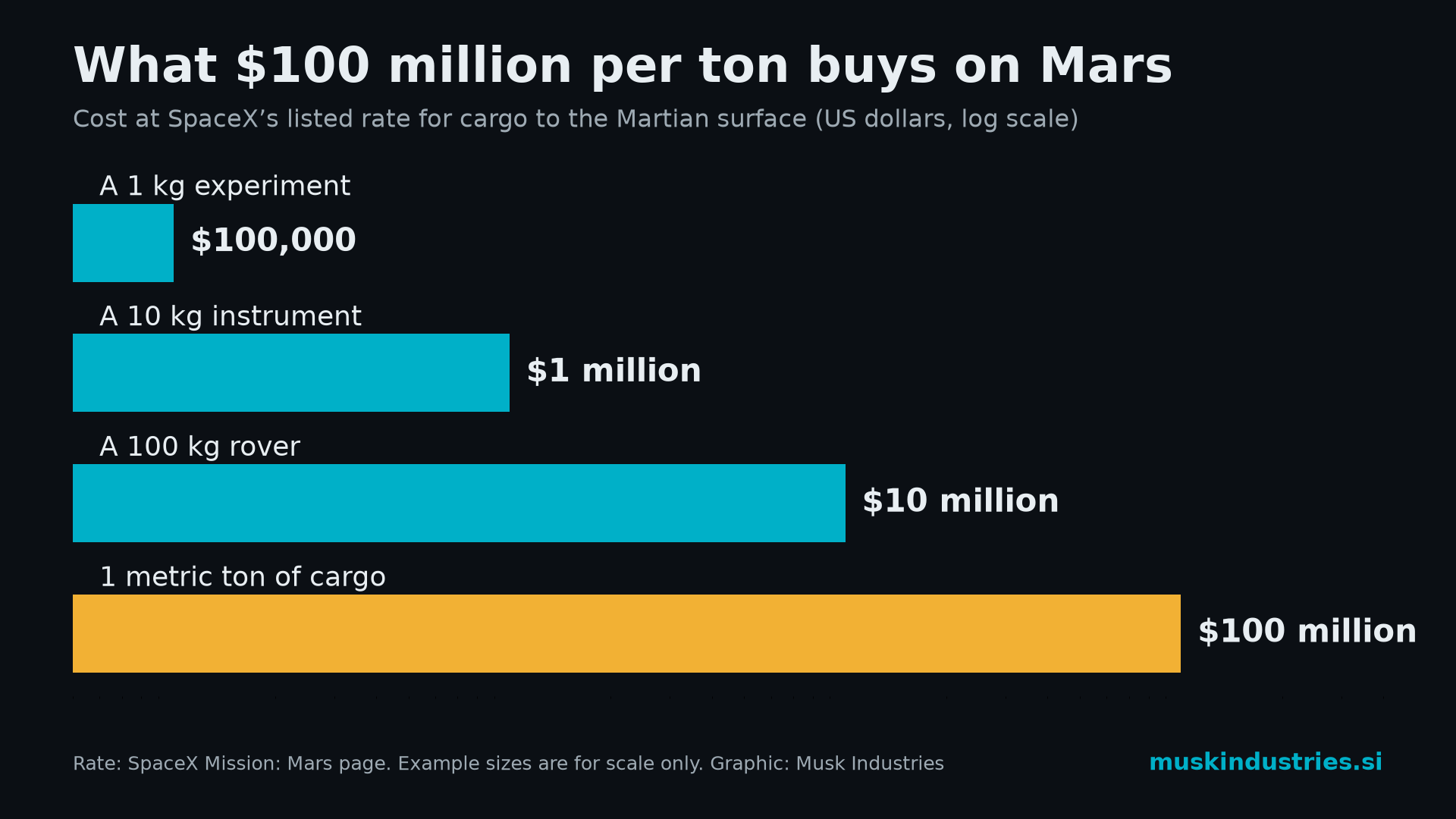
Short answer: SpaceX lists a price of $100 million per metric ton for Starship cargo delivered to the surface of Mars. That works out to $100,000 a kilogram, or about $100 a gram. SpaceX says these research, development and exploration cargo flights start no earlier than 2028.
Why it matters
Mars has always been the big Starship promise, but it usually comes with no numbers attached. A published price changes that. It means a university, a space agency or a company can now plan a Mars experiment the way it plans a satellite launch: work out the mass, multiply by the rate, and talk to SpaceX sales. It also shows what SpaceX thinks the first Mars flights are for: carrying paying science and equipment ahead of people.
How it works
The rate. SpaceX’s Mission: Mars page says Starship cargo flights to the Martian surface for research, development and exploratory missions start no earlier than 2028, “at a rate of $100 million per metric ton”. Customers contact SpaceX for payload masses, pricing details and timeframes.
The ship. Starship and its Super Heavy booster form a fully reusable system that SpaceX says is designed to carry more than 100 metric tons to orbit. To go on to Mars, a ship needs far more propellant than it has left after reaching orbit, which is why refuelling in space matters so much.
The timing. Earth and Mars line up for a transfer about every 26 months, so Mars flights leave in batches when a window opens. SpaceX says Starship will hit the Martian atmosphere at 7.5 kilometers per second and slow down aerodynamically, with a heatshield designed for multiple entries.
What’s real now
- Orbit: Flight 14 on 28 September 2026 was the first orbital Starship flight, and it delivered 26 Starlink V3 satellites. See Did SpaceX’s Starship reach orbit?
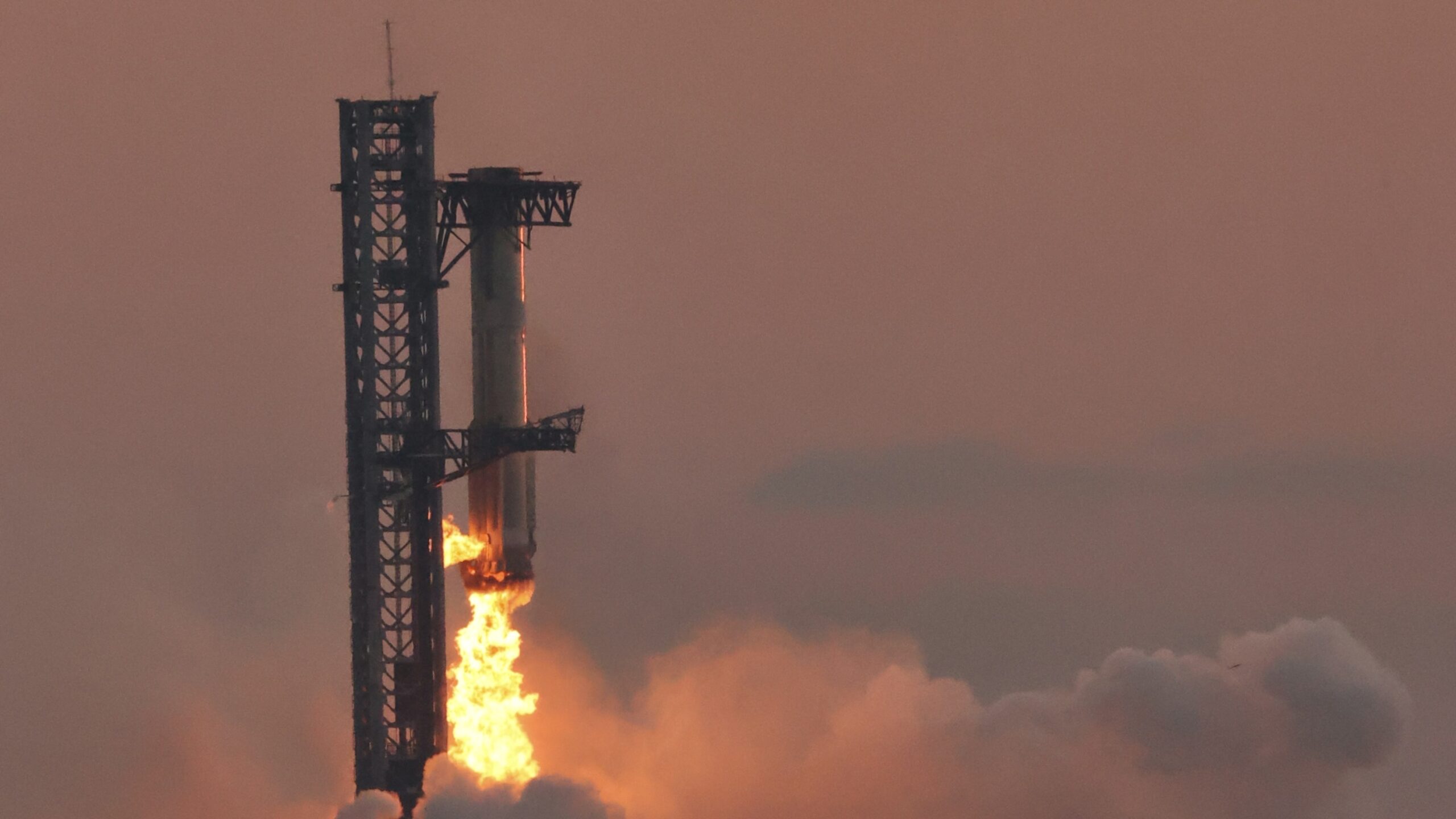
- Booster catches: three first generation Super Heavy boosters have been caught by the launch tower, and two have flown again, according to SpaceX. See Why does SpaceX catch boosters with chopsticks?
- Refuelling groundwork: SpaceX has moved about five tonnes of propellant between tanks inside one ship. Moving fuel from one Starship to another in orbit is still to come.
- SpaceX already flies huge mass: across all its rockets, SpaceX put 1,517 metric tons into orbit in the first nine months of 2026, including 476 tons in the third quarter alone.
Numbers
| Mars cargo at $100 million per metric ton | Cost |
|---|---|
| 1 gram | $100 |
| 1 kilogram | $100,000 |
| 10 kilograms | $1 million |
| 100 kilograms | $10 million |
| 1 metric ton | $100 million |

What’s next
- Flight 15 (done): in November 2026 the launch tower caught a Starship upper stage for the first time; the booster diverted to the Gulf. See Why is catching Starship such a big deal?
- Ship to ship refuelling: the step that lets a Starship leave Earth orbit fully fuelled. SpaceX says refuelling also lets Starship land up to 100 tonnes on the Moon.
- More flights a year: SpaceX plans Starbase, Louisiana, a spaceport built for thousands of Starship flights a year, with a first launch targeted for 2029.
- Mars cargo, no earlier than 2028: Elon Musk wrote on X in March 2025 that Starship would depart for Mars at the end of 2026, carrying Optimus. SpaceX’s Mars page now gives 2028 as the earliest start for surface cargo flights. We track both dates on the Musk Timeline Tracker.
- The money behind it: Starlink pays for much of this. See Where does SpaceX’s money actually come from?
We will update this page if SpaceX changes its Mars rate or dates.
Sources
- SpaceX: Mission: Mars: $100 million per metric ton, cargo flights no earlier than 2028, 100+ metric tons to orbit, 26 month windows, 7.5 km/s entry. Primary, read 13 November 2026.
- SpaceX Reports Third Quarter 2026 Results: mass to orbit, Flight 14 as first orbital Starship flight, lunar Starship payload contract, Starbase Louisiana. Primary.
- Starship Flight 14 (SpaceX) and Starship Flight 15 (SpaceX): orbit, 26 Starlink V3, booster catch history, double catch plan. Primary.
- To the Moon and Beyond (SpaceX, 30 October 2025): about five tonnes of propellant moved between tanks, up to 100 tonnes to the lunar surface with refuelling. Primary.
- Elon Musk on X, March 2025: Starship to depart for Mars at the end of 2026, carrying Optimus.
Top image and charts: Musk Industries originals from SpaceX’s published figures. Booster photo: Steve Jurvetson / Wikimedia Commons, CC BY 2.0.
Musk Industries is an independent archive, not affiliated with SpaceX, Tesla, Elon Musk or related companies.